
45 Fully Funded Scholarships at Stanford University 2026 – 2027: Top Stanford Scholarships and Knight-Hennessy Scholars
Are you dreaming of studying at one of the world’s top universities without worrying about money?
Fully Funded Scholarships at Stanford University 2026 give you complete financial coverage for tuition, living costs, travel, and academic expenses.
You can focus on your studies and future goals. Stanford, ranked among the top three global universities by QS World Rankings 2025, offers many prestigious funding options.
Both international and U.S. students can apply. Scholarships are available for undergraduate, master’s, and PhD programs.

You can explore programs like the Knight-Hennessy Scholars, Stanford Graduate Fellowship, and Presidential Scholarship.
Each award supports exceptional students in every field. Stanford works hard to remove economic barriers and promote global access to education.
Check out the details below for application guides, eligibility, and economic benefits for each scholarship.
Top 10 Stanford University Scholarships 2026 – 2027
| # | Scholarship Name | Sponsor / Program | Economic Benefits (USD) | Eligibility | Application Deadline (2026 Cycle) |
|---|---|---|---|---|---|
| 1 | Knight-Hennessy Scholars | Stanford University | Full tuition, housing, $42,000 stipend, travel | All nationalities, graduate | Oct 8, 2025 |
| 2 | Stanford Graduate Fellowship | Stanford University | Tuition + $50,400 stipend | PhD students | Varies by department |
| 3 | Stanford Presidential Scholarship | Stanford University | Full tuition + living allowance | Graduate students | Feb 2026 |
| 4 | Knight-Hennessy PhD Funding | Stanford University | Full ride, travel, research | PhD all disciplines | Oct 2025 |
| 5 | Stanford MBA Fellowship | Graduate School of Business | Up to full tuition + $45,000 yearly stipend | MBA candidates | June 2026 |
| 6 | Bechtel International Center Scholarship | Bechtel Foundation | Tuition aid + housing grant | International students | March 2026 |
| 7 | Stanford International Scholars Program | Global Scholarships Office | Full funding + travel | Undergraduate and graduate | Rolling 2026 |
| 8 | Stanford Engineering Fellowship | School of Engineering | Tuition + research stipend | Engineering master’s/PhD | Jan 2026 |
| 9 | Stanford Humanities Fellowship | Humanities & Sciences | Tuition + $40,000 stipend | Humanities students | Feb 2026 |
| 10 | Stanford Medical Fellowship | School of Medicine | Tuition, insurance, living costs | MD and PhD medical students | April 2026 |
1) Knight-Hennessy Scholarship Program

The Knight-Hennessy Scholarship Program at Stanford University is one of the most competitive and fully funded fellowships in the world for graduate students.
It welcomes up to 100 new scholars each year from all disciplines. The program is based in Stanford, California, USA.
Knight-Hennessy focuses on leadership development, interdisciplinary learning, and global impact.
You can apply if you are from the U.S. or any other country. The scholarship covers full tuition, living expenses, and academic fees for up to three years.
You may pursue any graduate or professional degree at Stanford, including master’s, PhD, JD, MD, or MBA programs.
The program values independence of thought, purposeful leadership, and a civic mindset.
You must apply separately to both Stanford’s graduate program and the Knight-Hennessy application.
The 2026 cohort deadline is October 8, 2025.
Knight-Hennessy Program Highlights
| Feature | Details (2025–2026 Cycle) |
|---|---|
| Host Institution | Stanford University, California, USA |
| Funding | Full tuition, stipend, housing, and travel allowance |
| Program Duration | Up to 3 years |
| Eligible Degrees | Master’s, PhD, JD, MD, MBA |
| Deadline for 2026 Intake | October 8, 2025 |
| Number of Scholars Selected Annually | Around 100 |
| Eligibility | Open to citizens of all countries |
| Focus Areas | Leadership, community service, global impact |
Stanford Graduate Admission Snapshot
| Metric | Data (Latest Available) |
|---|---|
| University Type | Private Research University |
| QS World University Ranking 2025 | #3 Globally |
| Acceptance Rate (Graduate) | ~5% overall |
| Application Fee (Stanford Graduate) | USD 125 per program |
| Median GRE (Quantitative) | 165 |
| Median GPA (Incoming Graduate Cohort) | 3.9 / 4.0 |
Quick Checklist for Applicants
- ✅ Apply separately to your Stanford graduate program.
- ✅ Complete the Knight-Hennessy Scholars (KHS) online application.
- ✅ Provide transcripts, recommendation letters, and a personal statement.
- ✅ Submit before October 8, 2025.
- ✅ Prepare for leadership and community involvement interviews if shortlisted.
The Knight-Hennessy Scholarship gives you the power to join a global network of future leaders.
Located in Silicon Valley, Stanford connects academic study with real-world innovation.
This makes it a top choice for ambitious graduate applicants seeking fully funded scholarships at Stanford University in 2026.
2) Stanford University Need-Based Financial Aid

Stanford University, ranked among the top 5 universities globally, offers one of the most generous need-based financial aid programs in the world.
Stanford meets 100% of demonstrated financial need for all admitted undergraduates.
You do not need loans to cover costs. If your family income is below $150,000 and you have typical assets, Stanford usually covers full tuition.
Families earning below $100,000 usually pay no tuition, room, or board.
The average total aid package for need-based recipients is $74,310 per year. This includes university and external grants.
Graduate students have access to full funding through programs such as the Knight-Hennessy Scholars.
These programs provide tuition, stipend, and academic support for all Stanford graduate degrees.
Table 1: Average Undergraduate Aid (2025-2026)
| Income Level (USD) | Expected Parent Contribution | Typical Coverage Provided |
|---|---|---|
| Below $100,000 | $0 | Tuition, room, board fully covered |
| $100,000–$150,000 | Low to moderate | Full tuition covered |
| Above $150,000 | Varies | Partial scholarship or grant support |
Table 2: Key Financial Aid Statistics (2025)
| Metric | Amount / Data |
|---|---|
| Average Scholarship from Stanford | $66,259 |
| Total Average Gift Aid | $74,310 |
| Loan Requirement | None (need met without loans) |
| % of Undergraduates Receiving Aid | ~50% |
Stanford combines federal, state, university, and private grants to ensure fairness.
You need to submit the FAFSA and CSS Profile to qualify.
Aid decisions focus only on financial need.
Stanford is one of the few elite schools offering debt-free education to eligible students.
3) Knight-Hennessy Scholars Fellowship

The Knight-Hennessy Scholars Fellowship at Stanford University is a highly competitive, fully funded graduate program.
You can apply for the 2026 cohort until October 8, 2025.
The program welcomes students from all countries and academic backgrounds.
It looks for independence of thought, purposeful leadership, and a civic mindset.
You will study at Stanford’s main campus in California, USA.
This campus is a global hub for innovation and technology.
The fellowship supports up to three years of graduate study in any Stanford school.
You can study Law, Medicine, Education, Business, Engineering, Humanities, or Sciences.
Each scholar receives full tuition coverage, a living stipend, and an annual travel allowance.
You also get academic and leadership development training.
Stanford offers you direct access to mentors, global events, and interdisciplinary research.
Table 1. Knight-Hennessy Scholars Fellowship Overview (2026 Cycle)
| Feature | Details |
|---|---|
| Host University | Stanford University (California, USA) |
| Degree Levels | Master’s, PhD, JD, MBA, MD, and joint degrees |
| Funding Type | Fully funded (tuition, stipend, travel) |
| Duration | Up to 3 years |
| Application Deadline | October 8, 2025 |
| Cohort Year | 2026 |
| Selection Focus | Leadership, Innovation, Civic Commitment |
Table 2. Financial Coverage Summary (Approximate Annual Value)
| Expense Category | Coverage | Notes |
|---|---|---|
| Tuition & Fees | 100% | Covered for the full program length |
| Living Stipend | USD 34,000–38,000 | For housing, meals, and personal costs |
| Academic Supplies | Included | Books, materials, and classroom needs |
| Travel Allowance | One annual trip | Round-trip to and from Stanford |
| Health Insurance | Fully covered | Stanford medical plan included |
Checklist: How to Apply Successfully
- ✅ Submit the KHS application and your Stanford graduate program application separately.
- ✅ Provide all transcripts, recommendation letters, and your résumé.
- ✅ Prepare a compelling leadership and purpose statement.
- ✅ Apply by October 8, 2025, to be considered for the 2026 intake.
The Knight-Hennessy Scholars Fellowship at Stanford University gives you the chance to get a world-class education and build leadership skills.
You can study in the United States with full financial support.
Explore your future at Stanford University. These scholarships can transform your life and career. Apply early, and take your first step toward a brighter, debt-free academic journey!
4) Stanford Graduate Fellowship

The Stanford Graduate Fellowship (SGF) in Science and Engineering stands out as one of Stanford University’s top programs for doctoral students.
You can pursue a PhD in engineering, natural sciences, or related fields with full financial support.
The SGF program began in 1997 and funds about 100 new scholars every year.
This fellowship creates a vibrant academic community focused on innovation and collaboration.
You gain access to world-class faculty, modern labs, and interdisciplinary opportunities across Stanford’s seven schools.
The program covers the first three years fully and then supports you through assistantships or university funding for later years.
Table 1. Stanford Graduate Fellowship — Key Details (2025–2026)
| Category | Details |
|---|---|
| Funding Coverage | Full tuition + annual living stipend + health insurance |
| Eligible Programs | PhD in Science, Engineering, Interdisciplinary Research |
| Duration | Up to 5 years (3 years fellowship + assistantship support) |
| Number of Fellows | ~100 new recipients each year |
| Founded | 1997 |
The fellowship rewards academic excellence, creativity, and leadership potential in research.
You receive professional development support and direct involvement in high-impact research projects.
Table 2. SGF Application Overview (for 2026 Intake)
| Stage | Timeline |
|---|---|
| Application Opens | September 2025 |
| Deadline | December 2025 (varies by department) |
| Notification Period | March–April 2026 |
| Academic Year Start | Autumn 2026 |
| Funding Renewal Reviews | Annually |
At a Glance Checklist
- Prepare GRE (if required by department)
- Submit research statement and letters of recommendation
- Apply to a Stanford PhD program
- Indicate SGF fellowship interest on your application
You get full financial support and join a dynamic research network at Stanford University.
This fellowship positions you for a strong academic and professional future.
5) Stanford Presidential Scholarship

The Stanford Presidential Scholarship is one of Stanford University’s most selective and generous funding awards for 2026.
It attracts highly accomplished students from all disciplines, supporting both domestic and international applicants for undergraduate or graduate study.
The scholarship fully covers tuition, housing, meals, and academic expenses.
Financial need will never limit your academic potential at Stanford.
Located in Stanford, California, the program fosters leadership, innovation, and public service.
Recipients join a community focused on research excellence and social impact in fields like engineering, humanities, and medicine.
You gain direct access to Stanford’s world-class faculty, advanced research centers, and a global professional network.
Table 1: Stanford Presidential Scholarship 2026 – Key Facts
| Feature | Details |
|---|---|
| Funding Type | Fully Funded |
| Eligibility | Undergraduate & Graduate, All Nationals |
| Coverage | Tuition, Housing, Meals, Books, Health Insurance |
| Duration | Full Program Duration |
| Application Cycle | Opens September 2025 for 2026 Entry |
The scholarship recognizes academic excellence, leadership promise, and contributions to community development.
Selection uses a competitive, holistic review that values intellectual merit, extracurricular distinction, and ethical leadership.
Table 2: Application & Selection Data (Estimated 2025–2026)
| Metric | Data |
|---|---|
| Acceptance Rate | ~2.5% |
| Average GPA | 3.95 (Unweighted) |
| Application Deadline | December 2025 |
| Required Documents | Essays, Recommendation Letters, Academic Records |
| Result Notification | March 2026 |
Review Stanford’s Office of Financial Aid and scholarship pages for instructions and eligibility.
The Presidential Scholarship combines full financial support with academic mentorship and leadership development.
6) Schwab Scholar Program

The Schwab Scholar Program at Stanford University offers full funding for graduate students focused on social innovation, public policy, and global leadership.
It connects closely with the Center on Democracy, Development and the Rule of Law and the Stanford Center for Social Innovation.
You gain mentorship, leadership training, and access to a global network of changemakers.
The Schwab Foundation for Social Entrepreneurship supports this unique opportunity.
Both U.S. and international students can apply for advanced degrees in policy, governance, or business.
The program emphasizes real-world leadership and evidence-based solutions.
Each scholar receives funding for tuition, living stipends, academic materials, and travel for field research or global leadership activities.
Key Program Metrics (2025–2026 Cycle)
| Metric | Details |
|---|---|
| Funding Coverage | 100% tuition, housing, and living stipend |
| Eligible Degrees | Master’s and PhD programs (policy, business, global studies) |
| Annual Scholars Selected | Approx. 8–10 globally |
| Application Opens | August 1, 2025 |
| Application Deadline | December 1, 2025 (for Fall 2026 intake) |
Admission & Selection Data
| Criteria | Requirement |
|---|---|
| Minimum GPA | 3.5 on a 4.0 scale |
| Language Proficiency | TOEFL iBT 100+ or IELTS 7.0+ |
| Experience Preferred | 2–5 years in leadership, policy, or impact-driven projects |
| Interview Round | March 2026 via virtual panel |
You stand out by showing measurable social impact and clear leadership experience.
A strong project proposal that aligns with the program’s vision is essential.
Ideal candidates combine academic excellence with a commitment to global problem-solving.
Checklist for Applicants
- Complete Stanford Graduate Admission and Schwab Scholar application.
- Submit a purpose statement linking your goals to social innovation.
- Provide three letters of recommendation.
- Include a one-page community impact summary.
The Schwab Scholar Program lets you connect deeply with Stanford’s research ecosystem and develop skills to drive measurable change.
It is one of Stanford’s top fully funded opportunities for global leadership training in 2026.
7) Knight-Hennessy PhD Funding

The Knight-Hennessy Scholars Program at Stanford University is one of the most competitive and generous PhD funding opportunities worldwide.
Founded in 2016 with a $750 million endowment, it supports up to 100 new scholars each year from all disciplines.
You can apply if you study engineering, social sciences, medicine, humanities, or other fields.
The program develops scholars who show both academic excellence and leadership.
You receive full tuition, a living stipend, academic fees, and travel grants for up to three years.
Stanford’s campus in California offers a diverse, interdisciplinary environment for innovation and global collaboration.
Key Features
- Fully funded for all PhD and joint degree programs
- Annual stipend covering living and research expenses
- Leadership training and multidisciplinary workshops
- Access to Stanford’s seven graduate schools
| Funding Component | Coverage Details (2026 Cycle) |
|---|---|
| Tuition and Fees | Full coverage for PhD duration (up to 3 years) |
| Stipend | Approx. $48,000 per year for living and academic costs |
| Travel Grant | One annual economy ticket for research or conferences |
| Health Insurance | Fully subsidized under Stanford’s Cardinal Care plan |
| Eligibility & Deadline | Key Facts (for 2026 Cohort) |
|---|---|
| Citizenship | Open to all nationalities |
| Application Deadline | October 8, 2025 |
| Degree Fields | All Stanford PhD, JD, MD, MFA, and dual-degree programs |
| Selection Criteria | Academic excellence, leadership, civic mindset |
Application Tips
- Apply separately to both the Stanford PhD program and Knight-Hennessy.
- Highlight leadership, independence, and community engagement.
- Submit by October 8, 2025, for the 2026 cohort.
- Prepare a clear statement of purpose that aligns with KHS goals.
Quick Facts (Visual Summary)
- 🏛 Founded: 2016
- 💰 Endowment: $750 million
- 🎓 Scholars per year: 100
- 🌍 Global representation: 60+ countries
- 📅 Duration: Up to 3 years fully funded
The Knight-Hennessy Scholars Program gives you funding and a lifelong network of peers, mentors, and innovators.
8) Full Tuition Coverage for Undergraduates

Stanford University offers full tuition coverage for undergraduates through its need-based financial aid program.
If your family’s annual income is below $150,000, Stanford usually covers 100% of tuition.
Families earning under $100,000 typically pay no tuition, room, or board costs.
This policy ensures that your ability to pay never limits access to a Stanford education.
You do not need loans to meet your financial need.
Stanford’s aid packages include grants and scholarships, so you can graduate without student debt.
International students qualify under similar need criteria.
This makes Stanford one of the most inclusive U.S. university funding models.
Key Funding Metrics
| Income Level (USD) | Typical Student Cost | Coverage Provided by Stanford |
|---|---|---|
| Below $100,000 | $0 | Full tuition + room & board |
| $100,000–$150,000 | Reduced cost | Full tuition |
| Above $150,000 | Sliding scale | Partial aid based on need |
| Aid Type | Components Covered | Average Value (2025) |
|---|---|---|
| Stanford Grant | Tuition, fees, housing | $60,000–$75,000 |
| External Scholarships | Tuition or living support | Varies by sponsor |
| Federal/State Grants | Tuition + supplies (U.S. only) | Up to $7,395 (Pell Grant) |
Quick Application Checklist
- Submit the FAFSA and CSS Profile by the priority deadline.
- Upload parental income documentation for need calculation.
- Check eligibility for QuestBridge and matched full-ride programs, including the Knight-Hennessy Scholarship 2026.
- Review updates for 2026–2027 cycles via the Financial Aid Office website.
These steps help you qualify for Stanford’s most generous undergraduate awards.
You can attend Stanford with your tuition costs fully covered.
9) Living Stipend for Knight-Hennessy Scholars

The Knight-Hennessy Scholars Program at Stanford University gives you a comprehensive living stipend. This support covers all your personal and academic expenses during graduate studies.
You can focus on your research, coursework, and leadership training without financial stress. The stipend includes housing, meals, books, local transportation, and personal expenses in Palo Alto, California.
Stanford’s Office of Graduate Financial Aid updates the stipend every year to match local living costs. You also get a travel stipend for an annual economy-class round trip to and from Stanford.
This allowance usually lasts up to three years, matching most degree programs. It adds flexibility for international and domestic scholars.
Table 1. Average Annual Living Stipend Details (2025–2026)
| Expense Category | Estimated Annual Support (USD) | Coverage Source |
|---|---|---|
| Housing and Meals | $30,000–$36,000 | Knight-Hennessy Fund |
| Books and Materials | $1,000–$1,500 | Included in Stipend |
| Personal and Local Travel | $3,000–$5,000 | Included in Stipend |
| International Airfare (Yearly) | $1,500–$2,000 | Travel Stipend |
You can manage your expenses confidently while you join research, leadership training, and campus activities. The program ensures no extra out-of-pocket costs for essential needs.
Table 2. Key Financial Coverage Comparison
| Support Type | Coverage Level | Funding Duration | Purpose |
|---|---|---|---|
| Full Tuition | 100% | 3 Years | Graduate Program Fees |
| Living Stipend | 100% | 3 Years | Housing, Food, and Supplies |
| Travel Stipend | Annual Trip | Yearly | One Round Trip to/from Stanford |
| Additional Funding | Variable | As Needed | Special Projects or Research Support |
As a Knight-Hennessy Scholar, you enjoy financial freedom and can focus on your academic journey at Stanford.
10) Travel Allowance in Knight-Hennessy Program

The Knight-Hennessy Scholars Program at Stanford University gives you a travel allowance each year. This benefit covers the cost of a round-trip ticket to and from Stanford.
You get the allowance at the start of every academic year. It usually pays for one economy-class round trip, adjusted for your location.
This support ensures equal access for all scholars, no matter where you live. The allowance works alongside other funding, like full tuition, living stipend, and academic expenses.
Stanford’s funding model lets you focus on your studies and leadership growth, not travel costs.
Table 1. Knight-Hennessy Travel Allowance Breakdown (2025–2026)
| Coverage Item | Description | Frequency |
|---|---|---|
| Airfare | Round-trip economy ticket to/from Stanford | Once per academic year |
| Travel Grant Release | Provided at program start or yearly | Annual |
| Additional Trips | Not routinely covered; subject to approval | Case-based |
| Adjustment | Based on travel distance and home country | Variable |
Table 2. Comparative Travel Funding Among Top U.S. Scholarships (2026)
| Scholarship Program | Annual Travel Coverage | Notes |
|---|---|---|
| Knight-Hennessy (Stanford) | Full round-trip airfare | Included in fully funded package |
| Rhodes (Oxford) | One arrival and one return | Start and end of program |
| Fulbright (U.S. State Dept.) | Round-trip international airfare | Standard for all grantees |
| Gates Cambridge | Round-trip airfare | Included for all levels |
| Schwarzman (Tsinghua) | Round-trip economy flight | Covered for all scholars |
11) Stanford MBA Fellowships


Stanford Graduate School of Business (GSB) ranks among the top three business schools worldwide. The school offers MBA Fellowships to help talented students from all backgrounds.
These fellowships often cover full tuition and living expenses for two years. Stanford GSB chooses candidates for fellowships based on academic excellence, leadership, and financial need.
You must first gain admission to the Stanford MBA program to be considered. Application deadlines align with MBA admission rounds: September (Round 1) and January (Round 2).
Table 1. Key Fellowship Details
| Feature | Description (2026 Cycle) |
|---|---|
| Eligibility | All admitted MBA students |
| Funding Coverage | Full tuition + living stipend + campus fees |
| Duration | 2 academic years |
| Selection Criteria | Merit & financial need |
| Deadline | Sept 2025 (R1) / Jan 2026 (R2) |
Stanford GSB also offers named fellowships for certain regions or missions. The Stanford Reliance Dhirubhai Fellowship fully funds Indian citizens, and the Arjay Miller Scholars Program rewards top academic performance.
More than 50% of MBA students receive fellowship support. Awards average $45,000 per year.
Fellowship recipients get more than funding—they join career coaching, leadership seminars, and networking programs.
Table 2. Notable Stanford MBA Fellowship Types
| Fellowship Name | Region / Focus Area | Funding Type |
|---|---|---|
| Stanford GSB Need-Based Fellowship | Global (all students) | Full or partial |
| Reliance Dhirubhai Fellowship | India | Full + travel aid |
| Stanford Africa MBA Fellowship | Sub-Saharan Africa | Full |
| Knight-Hennessy Scholars (MBA) | Global / Interdisciplinary | Fully funded |
If you win a Stanford MBA Fellowship, the award pays tuition and university charges. Any stipend supports your personal and living costs.
Prepare your documents early, like tax forms or sponsor details, for smooth financial processing.
12) Teaching Assistantships for Graduate Students

Teaching Assistantships at Stanford University offer you both financial support and hands-on academic experience. You help faculty with teaching and research as you complete your degree.
Stanford provides these roles across many departments, such as the Graduate School of Education and the Program in Science, Technology, and Society (STS). You must be enrolled full-time in a graduate program and maintain good academic standing.
Graduate students receive a salary paid bi-monthly plus a tuition allowance that covers part or all of tuition. These assistantships help you build classroom skills, improve communication, and gain research expertise.
Many doctoral students use assistantships after their fellowship funding ends.
Table 1. Typical Graduate Teaching Assistantship Compensation (AY 2025–2026)
| Component | Description | Value Range (USD) | Payment Frequency |
|---|---|---|---|
| Base Salary | Minimum university rate | $35,000–$44,000 per year | Paid twice monthly |
| Tuition Allowance | Covers enrolled units | Up to 100% of tuition | Applied per quarter |
| Health Insurance | University health plan included | Included | Annual |
Table 2. Eligibility and Appointment Details
| Criteria | Requirement |
|---|---|
| Enrollment | Full-time graduate status at Stanford |
| Citizenship | U.S. and international students |
| Appointment Level | Up to 50% Full-Time Equivalent |
| Duration | Usually 1 academic quarter or longer |
| Renewal | Based on performance and funding |
Teaching Assistantships are a key part of Stanford’s fully funded graduate education. They combine income, training, and tuition support so you can focus on your academic and professional growth.
13) Research Assistantships

Research Assistantships (RAs) at Stanford University offer paid academic employment and support your graduate research.
You work closely with faculty on funded projects that often match your dissertation or future publications.
RAs receive:
- Full tuition coverage
- Monthly stipend
- Health insurance through the Graduate Financial System (GFS)
You apply for RA positions through your department or research group after admission.
Funding usually covers 20–50% appointments, based on your workload and the academic term.
Most PhD programs guarantee this support as long as you maintain satisfactory academic progress.
Table 1. Research Assistantship Funding Overview (2025–2026)
| Funding Component | Typical Coverage | Notes |
|---|---|---|
| Tuition Allowance | 100% (up to 10 units/quarter) | Covers full graduate tuition |
| Monthly Stipend | USD 3,300–3,900 | Varies by department and appointment |
| Health Insurance Subsidy | 100% (Cardinal Care) | For appointments ≥25% |
| Duration | Quarterly or Annual | Renewable with progress |
RAs require 10–20 hours of research work per week.
Tasks include experiments, data analysis, programming, and literature review.
These roles help you build academic and technical skills and reduce your financial burden.
International students are fully eligible for assistantships under their student visa.
RAs are one of the most accessible fully funded options at Stanford for global applicants.
Table 2. Key Eligibility and Application Data
| Requirement | Description |
|---|---|
| Minimum Enrollment | 8–10 units per quarter |
| GPA Requirement | 3.0 or higher (typical) |
| Appointment Level | 25%–50% time (10–20 hrs/week) |
| Application Timing | After admission / via research faculty |
| Funding Sources | Grants, departmental budgets, fellowships |
A Research Assistantship lets you contribute directly to Stanford’s research while receiving full funding for your PhD or graduate studies.
This pathway combines financial stability with professional growth in a world-class academic environment.
14) Bechtel International Center Scholarships

The Bechtel International Center Scholarships at Stanford support students who want to study, research, or gain professional experience abroad.
The program connects undergraduates, graduate students, and recent alumni with fully funded opportunities that fit academic and personal goals.
Located on campus, the Bechtel Center helps you secure funding, prepare strong applications, and manage interviews.
You can find scholarships for many regions, disciplines, and durations.
Many awards cover tuition, travel, housing, and living stipends.
The Bechtel Office of Global Scholarships offers personalized advising and hosts workshops for competitive international grants and fellowships.
Table 1: Bechtel International Center Scholarships – Key Details
| Feature | Description |
|---|---|
| Location | Stanford University, Stanford, California, USA |
| Eligibility | Undergraduates, graduates, recent alumni |
| Funding Type | Fully funded – tuition, travel, housing, living |
| Focus Areas | Study, research, professional experience abroad |
| Application Support | Advising, interview prep, writing workshops |
The Bechtel team manages campus procedures for major international awards like Rhodes, Marshall, and Fulbright Scholarships.
Each year, several Stanford students win these awards with Bechtel’s guidance.
You get essay feedback and access to peer mentors who have won similar grants.
Table 2: Application Insights and Deadlines (2025–2026 Cycle)
| Scholarship Type | Application Opens | Deadline | Notable Benefits |
|---|---|---|---|
| Study Abroad Grants | April 2025 | August 2025 | Tuition + $4,000 stipend |
| Research Fellowships | May 2025 | October 2025 | Full research funding |
| Professional Internships Abroad | June 2025 | November 2025 | Monthly stipend + housing to cover living and academic expenses. |
For 2026, many Bechtel scholarships accept rolling or annual applications.
Visit the Bechtel International Center’s Office of Global Scholarships to start your global experience funding journey at Stanford.
15) Stanford International Scholars Program

The Stanford International Scholars Program (SISP) supports high-achieving international students with strong academic potential and leadership.
It offers fully funded financial support covering tuition, housing, and living costs for undergraduate and graduate studies.
Hosted in Stanford, California, SISP expands access for talented students worldwide facing financial barriers.
SISP values leadership, global engagement, and community contribution in the context of Stanford graduate degree programs.
Scholars receive mentorship, intercultural learning, and access to Stanford’s research network.
The program seeks applicants with excellent academic records and a passion for solving international challenges.
Table 1. Scholarship Coverage Summary
| Benefit Type | Description |
|---|---|
| Tuition and Fees | 100% covered for full degree duration |
| Housing and Meals | Full on-campus accommodation and meal plan |
| Living Stipend | Monthly allowance for personal expenses |
| Travel Support | Round-trip airfare for international students |
Table 2. Key Eligibility and Application Data (2026 Intake)
| Criteria | Details |
|---|---|
| Application Period | May 2025 – October 2025 |
| Degree Levels Supported | Bachelor’s, Master’s, PhD |
| Target Group | International students from all regions |
| Selection Focus | Academic excellence, leadership |
You apply online through Stanford’s Office of Global Scholarships website.
Prepare transcripts, proof of English proficiency (TOEFL or IELTS), recommendation letters, and a personal statement.
Check country-specific funding and nomination requirements before submitting your application.
16) Stanford Global Opportunity Grants

The Stanford Global Opportunity Grants (GOG) program helps undergraduates and graduates pursue study, research, and service projects abroad.
It supports students who need financial assistance to gain academic or professional experience internationally.
The Bechtel International Center’s Office of Global Scholarships manages the program.
You can use the grant for travel, housing, and project costs tied to courses, research, or community work overseas.
Both U.S. and international students at Stanford University are eligible.
Applications are reviewed for academic merit, project purpose, and global impact.
Table 1: Key Grant Details
| Feature | Details |
|---|---|
| Program Name | Stanford Global Opportunity Grants |
| Administered by | Bechtel International Center – Global Scholarships |
| Eligible Applicants | Undergraduates and graduates |
| Funding Type | Full/partial grant for international activities |
| Covers | Travel, lodging, research, project expenses |
| Application Cycle | Annually (Nov–March) |
Grant amounts typically range from $2,000 to $8,000.
Preference goes to proposals with strong academic or social value abroad.
You may combine this grant with other Stanford scholarships or external fellowships.
Table 2: Application and Selection Criteria
| Criteria | Description |
|---|---|
| Academic Standing | Minimum GPA 3.0 (undergraduates), good standing (graduates) |
| Project Proposal | Clear learning goals and outcomes |
| Financial Need | Considered but not required |
| Recommendation Letters | 1–2 faculty or supervisor letters |
| Announcement Dates | Spring term (for summer and fall cycles) |
Quick Checklist:
- Prepare a concise 2–3 page project proposal.
- Include a detailed budget and timeline.
- Obtain faculty approval for academic alignment.
- Submit through Stanford’s Global Scholarships portal before the deadline.
You can combine this funding with programs like Bing Overseas Studies or external fellowships for maximum support.
17) Stanford University Financial Aid Office Support

The Stanford University Financial Aid Office helps students access full financial support for undergraduate and graduate studies.
Located in Stanford, California, the office ensures admitted students can attend regardless of income.
It manages scholarships, grants, and on-campus jobs, focusing on need-based aid instead of loans.
Stanford meets 100% of demonstrated financial need through university scholarships and external resources.
Most aid comes from Stanford’s scholarship endowments, funded by donor gifts.
The office guides you in completing the FAFSA and CSS Profile to determine eligibility.
International, undergraduate, and graduate students can contact the office for advice on scholarships, budgeting, and financial planning.
Stanford supports programs like QuestBridge and Knight-Hennessy Scholars, providing pathways for fully funded study.
Table 1. Stanford University Financial Aid Key Metrics (2025–2026)
| Metric | Data (2025–26) | Source/Notes |
|---|---|---|
| Undergraduate Aid Recipients | ~70% | Stanford University |
| Average Scholarship Grant | $67,000/year | Stanford Financial Aid Office |
| Loans Required | None expected | Need-based; no loans policy |
| FAFSA/ CSS Deadline | Early Feb 2025 | Annual renewal required |
Table 2. Eligibility and Support Overview
| Category | Eligible Applicants | Type of Support | Application Documents |
|---|---|---|---|
| U.S. Citizens & Permanent Residents | Yes | Need-based scholarship, grants, work-study | FAFSA + CSS Profile |
| International Students | Yes | University scholarships and grants | CSS Profile only |
| Graduate Students | Yes | Fellowships, research funding, assistantships | Program forms |
| QuestBridge Applicants | Yes | Full-ride scholarship | QuestBridge + Stanford forms |
The Financial Aid Office is your partner for fully funded scholarships at Stanford University for 2026.
It ensures financial barriers never limit your access to one of the world’s top-ranked universities.
18) Stanford Office of Global Scholarships

The Stanford Office of Global Scholarships (OGS) operates inside the Bechtel International Center at Stanford University, California.
It serves over 8,000 international students and visiting scholars, guiding them to funding and global academic opportunities.
The office promotes cross‑cultural understanding and supports scholars at every academic level.
You can contact OGS to learn about university‑wide fellowships, U.S. government exchanges, and global partnerships.
OGS coordinates major award programs and advises on applications for Fulbright, Knight‑Hennessy, and other international scholarships.
The team helps with documentation and provides advising for funding, visas, and post‑award requirements.
Table 1. Overview of Stanford Office of Global Scholarships (2025–2026)
| Category | Detail |
|---|---|
| Administrative Unit | Bechtel International Center |
| Serving Population | 8,000+ international students & scholars |
| Key Scholarship Coordination | Knight‑Hennessy, Fulbright, DAAD, Rhodes, Marshall |
| Location | Stanford, California, USA |
| Advising Focus | Funding guidance, visa support, external award prep |
OGS works with the Financial Aid Office to make sure students who qualify for need‑based or fully funded scholarships get accurate information.
It offers targeted workshops for both graduate and undergraduate applicants, updating details each academic year.
Table 2. Services Offered by OGS
| Service Type | Description |
|---|---|
| Funding Advising | Guidance on Stanford and external scholarships |
| Global Programs | Coordination of international partnership awards |
| Application Resources | Personal statement and reference guidance |
| Cultural Programs | Events promoting cross‑cultural exchange |
| Compliance Support | Assistance with visa and academic documentation |
If you plan to apply for Stanford University fully funded scholarships in 2026, contact OGS early.
The office helps you meet eligibility criteria and keeps you updated on all funding timelines.
19) Stanford Diversity Scholarships

Stanford University offers Diversity Scholarships to support students from underrepresented backgrounds, first-generation college students, and international applicants.
These fully funded awards create a more inclusive academic community and help talented students join Stanford’s world-class programs.
Located in Silicon Valley, Stanford provides a vibrant space for innovation and global collaboration.
Each diversity scholarship covers full tuition, housing, and living expenses.
The program supports undergraduate and graduate students based on financial need, academic excellence, and campus inclusion.
Students in STEM, humanities, law, medicine, and social sciences can apply.
Key Scholarship Data
| Category | Details (2025–2026 Cycle) |
|---|---|
| Funding Type | Fully Funded |
| Coverage | Tuition, housing, meals, stipend, health insurance |
| Eligibility | Underrepresented, first-gen, and minority students |
| Deadline | Varies by program; typically Oct–Dec 2025 |
| Location | Stanford University, California, USA |
Diversity and Enrollment Metrics
| Student Group (Graduate + Undergraduate) | Approx. % of Total Enrollment (2025) |
|---|---|
| Women | 50% |
| Underrepresented Minorities (URM) | 27% |
| First-Generation College Students | 17% |
| International Students | 23% |
Stanford’s Office of Financial Aid and Knight-Hennessy Scholars often combine diversity funding.
You can add need-based awards to specialized funds like the Stanford IDEAL Fellowship or departmental diversity grants.
This ensures you get full support for your academic journey.
To apply, submit your admission application and complete the CSS Profile or FAFSA for need-based aid.
Include a personal statement that highlights your community impact, resilience, or leadership in diverse environments.
20) Stanford Merit-Based Scholarships

Stanford University awards a select number of merit-based scholarships to students who show exceptional academic achievement, leadership, or unique talents.
Most undergraduate funding at Stanford is need-based, but certain merit awards recognize top performance regardless of financial status.
You compete for these scholarships through academic excellence, community engagement, and innovation.
These awards attract top-performing students from all fields.
Notable examples include the Stanford Alumni Legacy Scholarship and donor- or corporate-funded distinctions.
They help offset tuition or living expenses for deserving students entering in 2026.
Merit scholarships often work with other financial aid.
Recipients must maintain strong academic standing to renew their award each year.
You usually apply automatically during the general application process; no separate form is required.
Table 1: Key Details – Stanford Merit-Based Scholarships (2026 Cycle)
| Criteria | Description |
|---|---|
| Eligibility | Exceptional academic record, leadership, creativity, or community service |
| Funding Type | Partial tuition or living stipend |
| Application Process | Automatic consideration with admission; no separate form |
| Renewal | Annual review based on academic performance |
| Deadline | Same as Stanford admission deadlines (Late 2025 for Fall 2026 entry) |
Table 2: Comparative Overview – Merit-Based vs. Need-Based Aid (Stanford 2026)
| Feature | Merit-Based Scholarship | Need-Based Award |
|---|---|---|
| Selection Basis | Academic excellence | Financial need |
| Award Amount | Varies by donor, often partial tuition | Covers up to full cost of attendance |
| Renewability | Dependent on performance | Based on updated financial data |
| Eligible Applicants | Domestic and international students | Domestic and international students |
| Application Requirement | Included with admission form | FAFSA + CSS Profile |
When you plan your 2026 Stanford application, focus on strong academics, extracurriculars, and leadership.
These qualities boost your chances for merit-based recognition and generous need-based aid.
21) Fully Funded Masters Scholarships

Stanford University offers several fully funded master’s scholarships that remove financial barriers for talented students worldwide.
The most famous is the Knight-Hennessy Scholars Program, which covers full tuition, living stipends, academic expenses, and round-trip travel for up to three years.
These awards support studies in engineering, business, law, medicine, education, and the arts.
You can pursue your master’s degree in any of Stanford’s seven schools in California.
The program values academic achievement, leadership, and global impact.
Each year, students from over 70 countries join.
The scholarship also provides leadership training and interdisciplinary learning.
Table 1. Overview of Stanford Fully Funded Masters Scholarships (2026 Cycle)
| Scholarship Name | Coverage | Eligible Degrees | Application Deadline (Approx.) | Funding Duration |
|---|---|---|---|---|
| Knight-Hennessy Scholars | Full tuition, living stipend, travel, health insurance | All master’s programs | October 2025 | Up to 3 years |
| Stanford Graduate Fellowships | Full tuition, research funds, living allowance | STEM master’s programs | Rolling | 1–2 years |
| Stanford Humanities Fellowships | Tuition + stipend | Humanities, Arts | Mid-2025 | 1 year (renewable) |
Applications usually open in summer 2025 for 2026 programs.
You must apply separately to your Stanford graduate program and the scholarship.
The Knight-Hennessy Scholars application includes an online assessment and a video statement.
Table 2. Key Selection Data (2024–2025 Admissions)
| Metric | Value | Source/Notes |
|---|---|---|
| Number of annual Knight-Hennessy Scholars | 100 | Official Stanford data |
| Average GPA of admitted master’s students | 3.8/4.0 | Stanford Institutional Research |
| Acceptance rate (graduate overall) | Approx. 8% | University admissions data |
| International scholars share | 35%–40% | Graduate Admissions Profile 2025 |
To strengthen your application, highlight leadership, academic excellence, and community engagement.
The committee values applicants who aim to solve real-world problems.
Checklist for Applicants
- Prepare both Stanford graduate and Knight-Hennessy applications.
- Secure academic and professional references early.
- Gather proof of English proficiency (TOEFL, IELTS).
- Submit by October 2025 for 2026 entry.
Stanford’s fully funded master’s scholarships help you learn from top faculty, access world-class research, and join a global network of leaders ready to make a difference.
22) Stanford Fellowship for Engineering Students

The Stanford Fellowship for Engineering Students gives full financial support to graduate researchers in the Stanford University School of Engineering in Palo Alto, California.
This program funds tuition, living expenses, and research activities for domestic and international students in science and engineering.
Stanford offers several merit-based fellowships, including the Stanford Graduate Fellowship in Science and Engineering (SGF) and the Summer Undergraduate Research Fellowship (SURF).
These programs encourage innovation, cross-disciplinary work, and leadership in technology and applied sciences.
Each year, about 100 doctoral students receive SGF awards with full tuition, a 12‑month stipend, and health insurance.
SURF welcomes 30–35 undergraduates for an eight-week summer research experience.
Participants work on cutting-edge projects with faculty mentors and prepare for graduate study.
Table 1: Fellowship Overview
| Program Name | Academic Level | Duration | Funding Coverage | Annual Award (Approx.) |
|---|---|---|---|---|
| Stanford Graduate Fellowship (SGF) | PhD | 3 Years | Tuition, Stipend, Insurance | $45,000–$50,000 |
| SURF (Engineering) | Undergraduate | 8 Weeks | Housing, Meals, Travel, Stipend | $6,000–$7,000 |
Table 2: Application and Eligibility Data
| Criteria | Details |
|---|---|
| Eligibility | Open to U.S. and international students |
| Fields of Study | Engineering, Computer Science, Applied Sciences offered in Stanford graduate degree programs. |
| Minimum GPA | 3.5 or equivalent |
| Application Cycle | Opens Fall 2025 for 2026 intake |
| Selection Basis | Academic merit, research potential, faculty recommendations |
You apply directly through the Stanford School of Engineering portal.
Departments nominate top applicants during admissions review.
The fellowship covers the full cost of study.
You can focus entirely on your academic and research goals.
Highlight your research experience, analytical skills, and a clear statement of purpose.
Show alignment with a Stanford faculty advisor’s research to boost your eligibility.
23) Stanford Fellowship for Humanities Students

The Stanford Fellowship for Humanities Students provides fully funded dissertation and postdoctoral awards for top scholars in the humanities and interpretive social sciences.
Located in Stanford, California, this program supports advanced PhD candidates and recent PhDs as they complete original research and teaching development at the Stanford Humanities Center (SHC).
You gain both financial stability and access to a vibrant academic community.
Each fellowship covers living expenses, tuition, and research costs.
The program encourages applicants from diverse institutions worldwide.
Fellows work with Stanford faculty, share research through workshops, and teach limited courses during the year.
The selection process values strong research proposals, interdisciplinary ideas, and clear scholarly impact.
Table 1: Key Facts — Stanford Fellowship for Humanities Students
| Category | Details (2025–2026 Cycle) |
|---|---|
| Host Institution | Stanford University, School of Humanities and Sciences |
| Funding Type | Fully Funded Fellowship |
| Eligibility | Doctoral students and recent PhDs in Humanities and Interpretive Social Sciences |
| Duration | 1 Academic Year (Renewable for Select Programs) |
| Location | Stanford, California, USA |
| Application Window | August–October 2025 (for 2026–27 cohort) |
Table 2: Funding Breakdown
| Expense Category | Covered by Fellowship |
|---|---|
| Tuition Fees | ✅ Fully Covered |
| Annual Living Stipend | ✅ Approx. USD 35,000–40,000 |
| Health Insurance | ✅ Included |
| Research Allowance | ✅ Up to USD 3,000 |
| Teaching Requirement | 1–2 Courses Per Year |
Apply if your research aligns with Stanford’s core humanities disciplines—such as History, Philosophy, Literature, or Linguistics.
The SHC welcomes projects that cross disciplines or use modern digital methods.
Fellows join a global network, participate in symposia, and receive mentorship.
You gain resources to strengthen your academic career at top institutions.
24) Stanford Fellowship for Social Sciences

The Stanford Fellowship for Social Sciences supports doctoral candidates in fields like sociology, political science, and anthropology.
Stanford University, based in California, hosts this prestigious program.
Stanford ranks among the top 5 universities worldwide (QS, Times Higher Education).
The fellowship promotes interdisciplinary research and provides full funding for tuition, living costs, and academic expenses.
You can receive the fellowship through programs like the Center for Advanced Study in the Behavioral Sciences (CASBS).
CASBS partners with global institutions, including the Chinese University of Hong Kong, National University of Singapore, and Riksbankens Jubileumsfond.
The program values scholarly excellence and societal engagement.
Table 1. Fellowship Overview
| Feature | Details |
|---|---|
| Host University | Stanford University |
| Location | Stanford, California, USA |
| Eligible Fields | Economics, Political Science, Sociology, Psychology, Anthropology |
| Funding Type | Fully Funded Fellowship |
| Application Cycle | Opens annually (Late 2025 for 2026–27) |
Fellows receive mentorship from senior researchers.
You gain access to Stanford resources such as research labs, data repositories, and cross-disciplinary initiatives.
Participants often collaborate on social policy, equity, and innovation projects.
These projects influence academic and public sectors worldwide.
Table 2. Funding and Benefits Summary
| Benefit Type | Description |
|---|---|
| Tuition & Fees | 100% covered by Stanford University |
| Living Stipend | Approx. USD 45,000 per academic year |
| Research Support | Grant allowances for data collection and travel |
| Mentorship Access | Senior faculty-led guidance at CASBS |
| Networking Opportunities | Collaboration with global researchers and social policy leaders |
This fellowship helps you advance high-impact social research.
You join a diverse academic community recognized for shaping policy and public understanding.
25) Stanford Fellowship for Business Students

The Stanford Fellowship for Business Students supports MBA and predoctoral candidates who want to address global business challenges through research and leadership.
The Stanford Graduate School of Business (GSB) in California offers this fully funded fellowship.
You receive academic training, mentorship, and financial aid that covers tuition, living costs, and research expenses.
The fellowship attracts talented students worldwide who aim to impact business, policy, and entrepreneurship.
You can apply if you are pursuing or planning to pursue graduate business studies at Stanford.
The program values academic excellence, leadership, and a strong commitment to social or entrepreneurial impact.
Fellows join mentorship networks that prepare them for doctoral studies or executive roles.
Table 1. Fellowship Overview
| Feature | Details |
|---|---|
| Host Institution | Stanford Graduate School of Business (GSB), California, USA |
| Type | Fully Funded Fellowship |
| Level | MBA or Predoctoral Program |
| Funding Coverage | Full tuition, living stipend, research and travel support |
| Eligibility | Domestic and international students with strong leadership and academic promise |
| Duration | Up to 2 years (predoctoral) or length of MBA program |
Funding includes up to 100% tuition support.
You receive a generous annual stipend for living expenses and research grants.
The fellowship connects you to Stanford’s innovation ecosystem in Silicon Valley.
You can collaborate with faculty, startups, and industry experts.
Table 2. Key Application Data for 2026 Intake
| Application Window | Evaluation Criteria | Program Focus Areas | Selection Rate |
|---|---|---|---|
| Opens: Fall 2025 | Academic merit, leadership, and impact potential | Entrepreneurship, Finance, Organizational Behavior, Global Management | ~7–10% |
Applicants typically need a strong GPA (3.7+), competitive GMAT or GRE scores, and relevant experience.
If selected, you join a global cohort of emerging business leaders.
26) Stanford Fellowship for Medical Students

The Stanford Fellowship for Medical Students (MedScholars Program) offers full funding for medical students pursuing original research in basic science, clinical, global health, or translational fields.
You receive support under the Medical Scholars Research 370 course, which combines academic credit and funding for research under Stanford faculty mentorship.
You can conduct projects within Stanford’s School of Medicine, affiliated hospitals, clinics, or other approved university departments.
The fellowship covers tuition, stipend, and research expenses during the research period.
The program emphasizes independent inquiry and professional development.
You prepare for academic, clinical, and research leadership roles.
Global health tracks offer international fieldwork for up to one year.
Table 1: Key Program Details
| Detail | Description |
|---|---|
| Program Name | Stanford Medical Scholars Research Fellowship |
| Eligibility | Enrolled Stanford MD students in good academic standing |
| Funding Type | Fully funded research fellowship |
| Duration | Typically 1–12 months; options for extended global research |
| Credit | Awarded as MedScholars Research 370 course units |
| Research Fields | Basic, clinical, translational, or global health research |
Table 2: Financial and Academic Benefits
| Benefit | Details |
|---|---|
| Tuition Coverage | 100% for authorized research term |
| Stipend (2025–26) | Approximately $34,000 annualized, prorated by project duration |
| Research Expenses | Includes materials, publication fees, and travel costs (for global projects) |
| Faculty Mentorship | Paired with Stanford Medical School faculty adviser |
| Academic Credit | Units applicable toward MD degree research requirements |
Application Tip: Apply through the MedScholars Portal at least one term before your intended research period.
International and dual-degree students can apply if they maintain active enrollment at Stanford.
27) Stanford Fellowship for Law Students

The Stanford Fellowship for Law Students provides strong financial and academic support to future lawyers dedicated to public service, teaching, and research.
Stanford Law School, based in California, ranks among the top 3 law schools globally (U.S. News 2025).
This fellowship system helps law students reduce debt while pursuing meaningful legal careers.
About 75–80% of Stanford Law students receive financial aid, including fellowships averaging $25,000–$28,000 per year.
Awards combine need-based tuition aid and public service grants.
Specialized fellowships, like the Thomas C. Grey Fellowship, fund teaching and research experience.
Table 1. Key Fellowship Features (2025–2026)
| Feature | Description |
|---|---|
| Institution | Stanford Law School, California, USA |
| Type | Fully funded / Need-based & merit fellowships |
| Coverage | Tuition, stipend, summer funding, loan repayment |
| Eligibility | JD students with financial need or public service focus |
| Average Fellowship Amount | $25,000–$28,000 per year |
Stanford’s financial aid model supports equity and access.
You can receive full or partial tuition coverage and loan forgiveness for public interest careers.
International students may seek support through the Knight-Hennessy Scholars program, which provides full funding for Stanford graduate programs.
Table 2. Stanford Law Financial Aid Snapshot
| Category | Data (2025) |
|---|---|
| JD Program Duration | 3 years |
| Students Receiving Aid | 75–80% |
| Median Fellowship Grant | $26,500 |
| Annual Program Cost (before aid) | Approx. $105,000 |
| Loan Repayment Support | Available for public interest graduates |
This fellowship program helps you pursue advanced legal training without overwhelming financial pressure.
As applications for 2026 admissions open, you can explore these fully funded opportunities through Stanford’s Financial Aid Office and public interest fellowship pathways.
28) Stanford Fellowships Covering Academic Expenses

Stanford University offers a range of fully funded fellowships for graduate students across all disciplines.
These awards help you focus on research, innovation, and leadership without financial stress.
They typically include tuition coverage, stipends for living costs, travel allowances, and funds for materials.
You can apply for fellowships through Stanford’s academic departments or central university programs.
Many awards, such as the Knight-Hennessy Scholars, provide funding across master’s, PhD, and professional degrees.
Stanford supports students from over 100 countries.
These programs attract students with high academic merit and leadership potential.
Funds often cover full tuition (up to $65,000 per year), annual travel stipends, and health insurance.
Table 1. Overview of Major Stanford Fellowships Covering Academic Costs (2026)
| Fellowship Name | Degree Levels | Annual Stipend | Tuition Coverage | Health & Travel Allowance |
|---|---|---|---|---|
| Knight-Hennessy Scholars | Master’s/PhD | $43,000 | 100% tuition | Yes |
| Stanford Graduate Fellowships (SGF) | PhD | $45,000 | Full | Partial |
| EDGE Fellowships | Graduate | $42,000 | Full | Yes |
| Stanford Interdisciplinary Graduate Fellowship (SIGF) | Doctoral | $46,000 | Full | Yes |
Most fellowships last for the full duration of the degree, usually two to five years.
You must maintain good academic progress and join leadership or community projects.
Table 2. Key Metrics and Application Data (2025–2026 Cycle)
| Metric | Value |
|---|---|
| Application Opens | Summer 2025 |
| Typical Deadline | October–December 2025 |
| Eligibility | All nationalities |
| Acceptance Rate (avg. fellowships) | ~5–8% |
| Annual Number of Fellows | 300+ |
| Funding Amount (Total per Scholar) | Up to $250,000+ |
Prepare a strong academic record, set clear research goals, and secure references that highlight leadership and innovation.
Stanford values academic excellence, independence, and real-world impact.
29) Stanford Scholarships Covering Room and Board

Stanford University scholarships for 2026 offer full coverage of tuition, room, and board for students who qualify for need-based aid.
This support lets you focus on academics without worrying about housing and meal costs.
Both undergraduate and graduate students can benefit from these awards.
Undergraduate aid meets 100% of demonstrated need with no loans required.
Families with incomes under $150,000 often pay nothing for tuition, room, or meals.
Graduate scholarships—like the Knight-Hennessy Scholars Program—also provide stipends for living and meal expenses.
You can enjoy a comfortable campus life with this support.
Table 1. Coverage Details for Stanford Room and Board Scholarships
| Funding Component | Undergraduate Aid (Need-Based) | Graduate Aid (Knight-Hennessy) |
|---|---|---|
| Room & Housing | Fully covered for eligible students | Fully covered through stipend |
| Meal Plan (Board) | Fully covered | Fully covered |
| Living Stipend | Based on family income | $45,000 annual average stipend |
| Travel Allowance | Limited coverage for qualifying students | One annual economy-class ticket |
Table 2. Key Metrics for 2026 Stanford Scholarship Support
| Metric | Undergraduate | Graduate |
|---|---|---|
| Family Income Cap for Full Support | $150,000 (approx.) | Not income-based |
| Loan Requirement | None | None |
| Funding Duration | 4 years | Program length (2–5 years) |
| Application Cycle | Fall 2025–Winter 2026 | Fall 2025–Winter 2026 |
Apply for this funding when you submit your admission application and required financial aid forms like FAFSA and CSS Profile.
The Knight-Hennessy application runs separately, with deadlines that vary yearly.
30) Stanford Scholarships Covering Health Insurance

Stanford University provides fully funded scholarships that include comprehensive health insurance for eligible students.
This benefit supports your medical needs throughout your academic program.
International students especially benefit since U.S. healthcare costs can be high.
Most fully funded scholarships—such as the Knight-Hennessy Scholars and university-wide graduate fellowships—cover tuition, living stipend, housing, and Stanford Cardinal Care health insurance.
You can access on-campus health services, mental health support, and hospital care with minimal out-of-pocket costs.
| Scholarship Program | Health Insurance Coverage | Level of Study | Eligible Students |
|---|---|---|---|
| Knight-Hennessy Scholars | Full Stanford Cardinal Care plan | Graduate (All disciplines) | Domestic & International |
| Stanford Graduate Fellowships | Health insurance + dependent subsidy | PhD | Domestic & International |
| Medical Scholars Research Fellowship | Health insurance for research duration | MD | Medical Students |
| Key Features | Details (2026 Intake) |
|---|---|
| Health Insurance Provider | Stanford Cardinal Care (Aetna) |
| Coverage Period | Full academic year (renewable) |
| Included Benefits | Preventive care, hospitalization, mental health, pharmacy |
| Estimated Value | $5,100–$6,000 per student annually |
You must maintain full-time enrollment to stay eligible for health coverage under these scholarships.
If you bring dependents, some programs provide partial subsidies for spouse or child insurance.
Check specific program details during application since coverage conditions can vary.
For 2026 admissions, health coverage remains a core part of Stanford’s support for scholars.
You can focus on your studies and research without worrying about medical costs.
31) Stanford Scholarships Covering Travel Costs

Stanford University offers several fully funded scholarships that include travel allowances for international and domestic students.
These programs help all scholars attend global academic events and relocate comfortably to and from campus each year.
The Knight-Hennessy Scholars Program provides an annual travel stipend for one round-trip, economy-class ticket.
This funding covers flights from your home country to Stanford at the start of the academic year, and a return ticket after completion.
Other Stanford scholarships, including university-wide graduate fellowships, may offer additional travel grants for research conferences or fieldwork.
You can gain hands-on experience, collaborate globally, and expand your professional network.
Table 1: Key Travel Funding Features (Stanford Scholarships 2026)
| Funding Component | Details (2026 Intake) | Eligibility | Frequency |
|---|---|---|---|
| Annual Travel Stipend | Round-trip, economy-class airfare | All Knight-Hennessy Scholars | Once per academic year |
| Relocation Grant | Covers moving and baggage costs | New international students | One-time |
| Conference Travel Support | Funding for research-related events | Graduate recipients | Case-by-case |
| Fieldwork Allowance | Travel support for academic projects | PhD and master’s students | Variable |
Table 2: Estimated Travel Support Values (as of 2025-2026 cycle)
| Allowance Type | Approx. Amount (USD) | Source/Program | Notes |
|---|---|---|---|
| Airfare (Annual) | $1,200–$1,800 | Knight-Hennessy | Based on location |
| Relocation Grant | $500–$1,000 | Stanford Graduate Fellowships | One-time payment |
| Conference Support | Up to $2,000 | School or Department budget | Competitive funding |
| Field Research Trips | $1,000–$3,000 | Departmental funds | Varies by research needs |
These travel benefits help you focus on academics without financial strain.
Stanford’s approach ensures equal opportunity access for students from any continent.
Annual travel and relocation support encourage diversity and global collaboration.
32) Stanford Scholarships without Language Test Requirements

Stanford University offers fully funded scholarships for 2026 that do not require standardized English language tests like TOEFL or IELTS for some applicants.
These scholarships target students with prior English-medium education or strong academic English skills.
Stanford wants to make the application process more inclusive for international students who studied in English-speaking schools or programs.
These scholarships apply to Bachelor’s, Master’s, and Ph.D. programs in engineering, humanities, business, and social sciences.
You can show English proficiency through interviews, written work, or academic records instead of formal tests.
This approach reduces financial barriers and expands access to qualified candidates worldwide.
Table 1: Key Features of Stanford Scholarships Without Language Tests (2026)
| Feature | Details |
|---|---|
| Target Applicants | International and U.S. students |
| Eligible Degrees | Bachelor’s, Master’s, Ph.D. |
| Funding Coverage | Full tuition, housing, living stipend, and travel |
| Test Requirement | No TOEFL/IELTS if prior English-medium instruction |
| Application Year | 2025-2026 Cycle |
Some of the most recognized programs, including the Knight-Hennessy Scholars Program, follow this inclusive policy.
Applicants must submit transcripts, essays, and recommendations.
You may be exempt from standardized English tests if you meet specific academic criteria.
Table 2: Examples of Test-Optional Stanford Scholarship Programs for 2026
| Program Name | Degree Level | Funding Type | Language Test Requirement |
|---|---|---|---|
| Knight-Hennessy Scholars | Master’s, Ph.D. | Fully Funded | Test optional |
| Stanford Graduate Fellowships | Ph.D. | Fully Funded | May waive tests |
| Stanford Undergraduate Aid | Bachelor’s | Need-based, Full Aid | May waive tests |
Check each program’s eligibility page. Requirements can differ by department.
Many graduate fields allow flexibility with English tests if you studied in English or your country’s main academic language is English. This makes the process easier while keeping standards high.
Verify department-specific English waiver policies early. Stanford’s full funding options make applying more accessible for global students in 2026.
33) Knight-Hennessy Scholarship for International Students
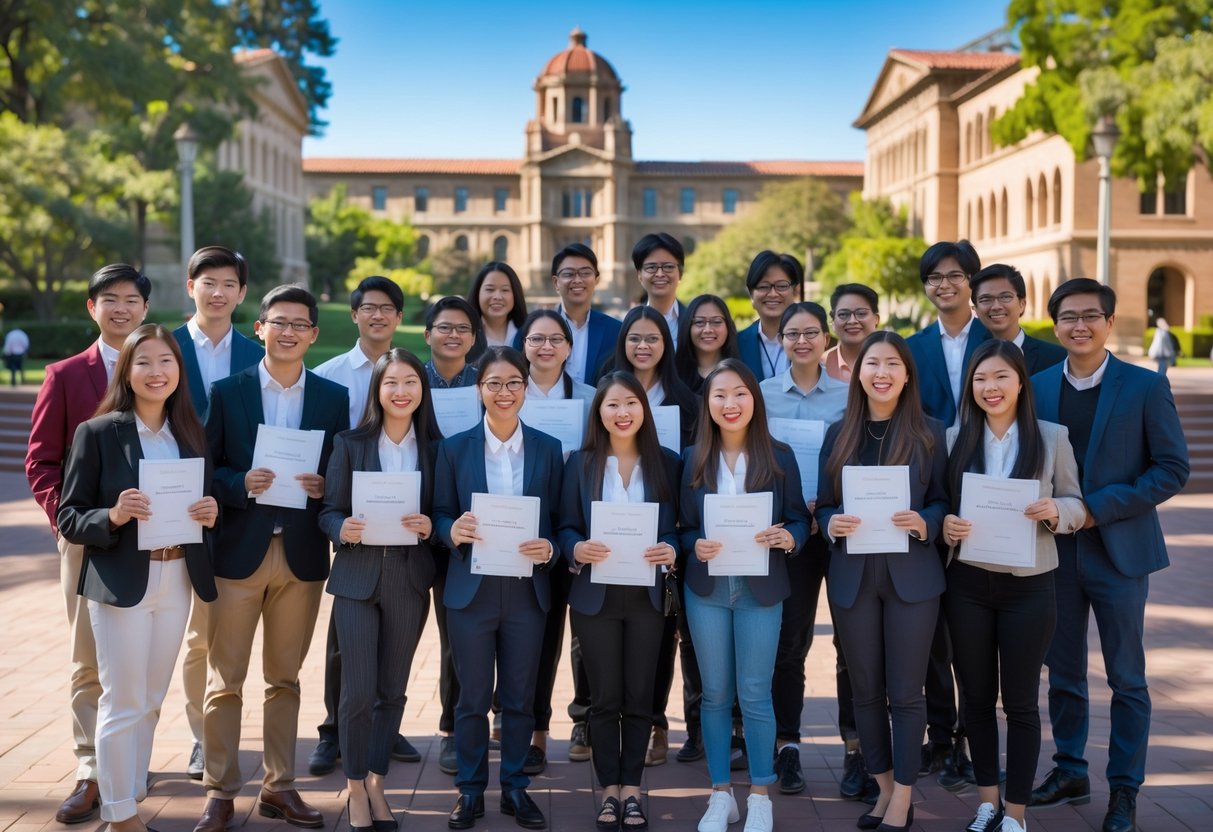
The Knight-Hennessy Scholarship at Stanford University supports top international and U.S. students pursuing graduate degrees. The program is based in Stanford, California.
You get up to three years of fully funded study. The scholarship encourages leadership, innovation, and interdisciplinary collaboration.
You can apply for MA, MS, MBA, MD, JD, MFA, PhD, and joint or dual-degree programs. The program aims to develop global leaders with strong ethics and a community focus.
| Key Feature | Details (2026 Intake) |
|---|---|
| Host University | Stanford University, USA |
| Scholarship Level | Master’s, PhD, and Professional Degrees |
| Funding Coverage | Full tuition, living stipend, housing, academic expenses, travel allowance |
| Duration | Up to 3 years (extendable in some cases) |
| Application Deadline (approx.) | October 2025 for 2026 entry |
| Number of Scholars Selected Annually | About 100 worldwide |
The Knight-Hennessy Scholars community includes students from over 75 countries. Scholars join immersive programs on leadership, global problem-solving, and personal development through the King Global Leadership Program (KGLP).
| Eligibility Overview | Requirements |
|---|---|
| Academic Excellence | Bachelor’s degree earned in 2019 or later |
| English Proficiency | Required for non-native speakers (TOEFL 100 iBT recommended) |
| Nomination Needed | No – direct application allowed |
| Additional Criteria | Demonstrated leadership, independent thinking, civic mindset |
| Eligible Fields | All graduate fields at Stanford |
Application Steps:
- Apply to Stanford University and Knight-Hennessy separately.
- Submit transcripts, test scores (if required), résumé, personal statement, and recommendation letters.
- If shortlisted, attend an interview.
Timeline Snapshot:
- Application Opens: Spring 2025
- Deadline: October 2025
- Interviews: Early 2026
- Results and Enrollment: Fall 2026
Quick Checklist for Applicants
- Verify Stanford program eligibility
- Submit both applications before deadlines
- Prepare leadership essay and personal statement
- Obtain at least two strong recommendation letters
The Knight-Hennessy Scholarship gives you more than funding. You join a lifelong network of peers and mentors dedicated to advancing global progress.
34) Stanford Full Ride Scholarships for PhD

Stanford University offers fully funded PhD scholarships. These cover tuition, health insurance, and living expenses for all admitted doctoral students.
You study in one of the world’s top research universities. Stanford’s funding lets you focus on research without financial worries.
Funding packages include fellowships, assistantships, and stipends. Most departments guarantee funding for at least five years if you make academic progress.
International and domestic students both receive this funding guarantee. You can also apply for the Knight-Hennessy Scholars program, which provides three years of full funding for any Stanford graduate degree.
Table 1: Stanford PhD Funding Overview (2025–2026)
| Component | Coverage Details | Duration |
|---|---|---|
| Tuition and Fees | 100% covered for all admitted PhD students | Up to 5 years |
| Living Stipend | Approx. $47,000–$52,000/year (varies) | Annual renewal based on progress |
| Health Insurance | Provided through Stanford University | Duration of enrollment |
| Research/Teaching Assistantship | 10–20 hours weekly with full benefits | Typically 3–5 years |
Table 2: Key Stanford PhD Full-Funding Programs (2026 intake)
| Scholarship/Fellowship | Eligibility Focus | Funding Period | Additional Benefits |
|---|---|---|---|
| Stanford University Fellowship | All PhD admits | 5 years | Tuition, stipend, insurance |
| Knight-Hennessy Scholars Program | Domestic & international students | 3 years | Leadership training, global networking |
| School/Departmental Fellowships | Discipline-specific PhDs | Varies | Research and travel grants |
Check your department’s timeline and the Graduate Admissions portal for assistantship and external funding options.
35) Stanford Fully Funded Graduate Programs

Stanford University in California offers fully funded graduate programs for 2026. These programs provide tuition coverage, living stipends, and research support.
You can pursue master’s and doctoral degrees in fields like engineering, business, humanities, medicine, education, and law. The Knight-Hennessy Scholars Program stands out for its generosity and competitiveness.
Each year, the program supports up to 100 scholars from all over the world. The award covers full tuition, a living stipend, and travel expenses for any Stanford graduate program.
Table 1: Stanford Graduate Program Data (2025–2026)
| Metric | Data (Approx. 2025–2026) |
|---|---|
| Global Ranking (QS 2025) | #3 |
| Acceptance Rate (graduate) | 4–6% |
| Average GRE (admitted students) | 165 Verbal / 168 Quantitative |
| International Student Ratio | 34% |
| Application Deadline (Fall 2026) | October 8, 2025 (Knight-Hennessy) |
Stanford funds graduate research through assistantships and university fellowships. Teaching and research assistants receive full tuition and a monthly salary.
These programs attract top academic talent. You get mentorship, career training, and access to Stanford’s global alumni network.
Table 2: Key Benefits of Fully Funded Stanford Graduate Programs
| Benefit | Description |
|---|---|
| Full Tuition Coverage | 100% of tuition for all approved years |
| Living Stipend | Monthly allowance based on local living costs |
| Health Insurance | Full coverage under Stanford Student Health plan |
| Travel Grant | Annual flight allowance for international students |
| Academic Support | Research funding, conference grants, mentorship |
Apply online through the Stanford portal. Submit all required department materials.
All Knight-Hennessy applicants must complete a separate scholarship application. Deadlines vary, so plan early.
36) Stanford Fully Funded Undergraduate Programs

Stanford University ranks among the top 5 universities globally (QS 2025). Its fully funded undergraduate programs remove financial barriers for admitted students through the Stanford Need-Based Financial Aid Program.
Stanford guarantees to meet 100% of demonstrated financial need with no loans. This covers tuition, room, board, and other costs.
Both U.S. and international students receive support. Families under certain income thresholds often pay nothing for tuition.
Stanford partners with QuestBridge to offer full-ride scholarships for high-achieving, low-income students entering in 2026.
Table 1: Key Financial Aid Coverage
| Coverage Type | Description | Amount Covered (Approx.) |
|---|---|---|
| Tuition | Full coverage based on need | Up to $61,731/year |
| Room & Board | On-campus housing and meal plan | Up to $18,619/year |
| Books & Supplies | Textbooks and academic materials | About $1,000/year |
| Personal Expenses | Health insurance, transport, misc. | Up to $3,000/year |
Stanford determines aid through the FAFSA and CSS Profile. They review household income, assets, and financial context worldwide.
Aid is renewable each year if you stay in good academic standing and reapply before deadlines.
Table 2: Admission and Scholarship Statistics (2025 Cycle)
| Metric | Data 2025 | Notes |
|---|---|---|
| Acceptance Rate | 3.9% | Among the most selective globally |
| Median SAT Range | 1500–1570 | Updated for 2025 entry |
| Median ACT Range | 34–35 | Reflects top global applicants |
| Students on Aid | 70% U.S. undergraduates | Need-based only |
| Average Aid Package | $62,557 | Covers over 80% of costs |
Apply through the Stanford undergraduate admissions portal. Financial aid applications open in October, with January priority deadlines for fall 2026.
All admitted students, regardless of citizenship, are considered for university scholarships after submitting financial documents.
Checklist for Applicants:
- Complete Stanford Application (Common App/Coalition App)
- Submit FAFSA & CSS Profile before deadline
- Upload parental tax and income documents
- Indicate QuestBridge participation (if eligible)
- Confirm acceptance and financial aid award before enrolling
At Stanford, your education depends on ability and ambition—not income. This makes it one of the world’s most inclusive full-funding opportunities.
37) Stanford Full Funding for Study Abroad Participants

Stanford University offers full financial support for students joining official study abroad or overseas research programs.
The Bechtel International Center’s Office of Global Scholarships manages this funding.
You receive coverage for tuition, travel, housing, and living expenses when you enroll in Stanford-sponsored programs abroad.
Any eligible student can participate, regardless of financial background.
Funding focuses on the Bing Overseas Studies Program (BOSP).
You can take courses or do research at partner centers in Oxford, Florence, Madrid, Kyoto, and more.
Financial aid matches the support you get on campus.
You don’t pay more to study abroad.
Stanford also supports external global fellowships like Rhodes, Marshall, and Fulbright.
The Office of Global Scholarships provides advising, interview prep, and funding strategies for these competitive awards.
Table 1. Financial Coverage for Stanford Study Abroad Participants
| Funding Component | Coverage Level (2026) | Notes |
|---|---|---|
| Tuition | 100% | Matches Stanford on-campus tuition rate |
| Travel (round-trip airfare) | Full or partial | Based on program or region |
| Housing & Meals | 100% | Equivalent to on-campus room and board |
| Health & Safety Support | Included | Comprehensive international coverage |
| Stipend for personal costs | $3,000–$5,000 per term | Estimated average support per student |
Table 2. Key Data: Participation and Eligibility (2025–2026 Cycle)
| Metric | Data (Approx.) | Source/Note |
|---|---|---|
| Annual Participants | 900+ Stanford students | Bing Overseas Studies data |
| Eligibility | Undergraduate/Graduate | Must be enrolled at Stanford |
| Funding Type | Need-based and merit-based | Verified through Financial Aid Office |
| Application Window | Dec 2025–Mar 2026 | Program-specific deadlines |
| Partner Locations | 10+ global sites | Europe, Asia, Africa, Latin America |
You keep your Stanford aid package and get extra travel support.
You gain professional and research opportunities—without extra financial risk.
38) Stanford Fellowships Supporting Research Expenses

Stanford University offers several fellowships and grants for research-related costs.
You can get funding for fieldwork, equipment, travel, or publication expenses.
Both graduate and postdoctoral scholars benefit from these awards.
Many fellowships supplement teaching or research assistantships.
The Vice Provost for Graduate Education (VPGE) funds over 400 fellows each year.
Nine university-wide programs offer research and innovation awards.
Departments also provide small research grants or summer fellowships.
International and domestic students can apply.
Many fellowships require faculty endorsement or a Stanford nomination.
Awards vary by discipline but often cover materials, research tools, or academic travel.
Table 1: Stanford Research Fellowships Overview (2025–2026 Cycle)
| Fellowship Name | Target Group | Average Award (USD) | Coverage | Application Period |
|---|---|---|---|---|
| VPGE Research Grant | Graduate Students | $5,000 | Research materials, travel | Feb–Apr 2025 |
| GSE Dissertation Support | Education PhD Candidates | $7,500 | Fieldwork, transcription, data collection | Oct–Dec 2025 |
| Interdisciplinary Graduate Fellowship | Doctoral Candidates | $8,000 | Multi-department research | Mar–May 2025 |
| Knight-Hennessy Scholars Supplement | All Grad Levels | Variable | Research + leadership projects | Aug–Oct 2025 |
| Postdoctoral Support Fund | Postdoctoral Scholars | $6,500 | Travel, publication costs | Rolling |
Table 2: Core Research Expense Categories Covered
| Expense Type | Description | Standard Amount Covered (USD) |
|---|---|---|
| Research Materials | Lab supplies, instruments, software | $1,000–$3,000 |
| Travel & Fieldwork | Data collection, site visits, conferences | $2,000–$5,000 |
| Publication Fees | Journal or open-access costs | $500–$1,500 |
| Equipment | Laptops, recorders, field kits | Up to $2,500 |
| Data Access | Database or archive fees | $300–$1,000 |
You should apply based on your project’s stage and funding needs.
Meeting deadlines, securing faculty recommendations, and submitting a clear budget will boost your chances.
39) Knight-Hennessy Annual Travel Stipend

The Knight-Hennessy Scholars Program at Stanford University provides a generous funding package for graduate students.
Each scholar receives an annual travel stipend for one round-trip, economy-class flight between their home country and Stanford.
This benefit helps you stay connected to home during your studies.
The travel stipend works alongside other funding like full tuition, living allowance, and academic expense coverage.
Stanford pays the stipend before each academic year, so you can plan travel easily.
Table 1: Knight-Hennessy Travel Stipend Overview
| Feature | Description |
|---|---|
| Frequency | Once per academic year |
| Travel Class | Economy |
| Covered Route | Home country ↔ Stanford University |
| Purpose | Annual round-trip for personal or academic reasons |
| Payment Schedule | Disbursed at the start of each academic year |
Stanford’s commitment to accessibility and global diversity shines through this program.
Scholars come from 70+ countries.
Travel assistance keeps the community globally connected.
Recipients use this stipend for collaborations, family visits, or conferences.
This support removes travel-related financial stress.
You can focus on your studies and research.
Table 2: Sample Annual Cost Coverage for Knight-Hennessy Scholars
| Expense Category | Approximate Annual Value (USD) | Covered by Knight-Hennessy Program |
|---|---|---|
| Tuition & Fees | $60,000–$75,000 | ✅ Yes |
| Living Stipend | $40,000–$45,000 | ✅ Yes |
| Travel Stipend | $1,000–$2,000 (est.) | ✅ Yes |
| Health Insurance | $5,000 | ✅ Yes |
| Academic Materials | $2,000 | ✅ Yes |
Stanford University’s fully funded scholarships in 2026 break down barriers for talented students everywhere.
You gain equal access to a top graduate education through Stanford graduate degree programs.
40) Stanford Scholarships for STEM Fields

Stanford University awards fully funded scholarships for students in science, technology, engineering, and mathematics (STEM).
These scholarships attract top undergraduates and graduate researchers worldwide.
Stanford’s STEM scholarships cover tuition, housing, living stipends, research materials, and travel.
The Knight-Hennessy Scholars Program is a leading STEM funding opportunity.
It supports master’s and PhD students in fields like computer science, bioengineering, mathematics, and physics.
The Stanford SURF (Summer Undergraduate Research Fellowship) gives international students a fully funded, eight-week research experience.
This takes place within the School of Engineering.
Key Scholarship Metrics
| Scholarship Name | Degree Level | Funding Coverage | Application Period | Focus Area |
|---|---|---|---|---|
| Knight-Hennessy Scholars | Master’s, PhD | Full tuition, Living stipend, Travel grant | Sept–Oct 2025 | Multidisciplinary STEM |
| Stanford SURF Fellowship | Undergraduate | Tuition, Housing, Research stipend | Feb–Mar 2026 | Engineering & Applied Sciences |
| Eligibility Criteria | Selection Basis | Duration | Global Student Participation | Annual Slots |
|---|---|---|---|---|
| GPA ≥ 3.7 or equivalent | Academic merit & research potential | 1–5 years | 100+ countries | ~80 Knight-Hennessy, ~35 SURF |
Prepare strong academic references and detailed research proposals.
Update your standardized scores if needed.
Show clear alignment with Stanford’s research mission and a passion for global STEM innovation.
41) Stanford Scholarships for Arts and Design

Stanford University supports creative students through its Arts and Design Scholarships.
These scholarships help students in visual arts, design, music, theater, and film.
Located in California, Stanford blends artistic practice with innovation and research.
You can apply for need-based and merit-based funding.
This funding covers tuition, housing, and academic costs for 2026 entry.
Over 70% of incoming Arts undergraduates receive financial aid.
Graduate students often get full fellowships through the Stanford Arts Institute and the Knight-Hennessy Scholars Program.
These opportunities support interdisciplinary work connecting technology, ethics, and culture.
Funding Snapshot (2025–2026 Cycle)
| Scholarship Type | Coverage | Eligible Level | Application Window |
|---|---|---|---|
| Stanford Arts Fellowship | Full tuition + stipend | Graduate | Autumn 2025 – Winter 2026 |
| Stanford Need-Based Arts Grant | Up to 100% of demonstrated need | Undergraduate | Rolling (Check CSS/FAFSA deadlines) |
Program Stats and Key Details
| Metric | Data (Latest Available) |
|---|---|
| Acceptance Rate (Arts Majors) | ~4.7% |
| Average Scholarship Award | $68,500 per year |
| Median Portfolio Rating (Scale 1–7) | 6.1 |
| Average Class Size | 10–15 students |
Prepare a digital portfolio, an artist statement, and academic transcripts for your application.
Full funding awards often consider your leadership in creative or community projects.
You can combine these scholarships with external grants like Fulbright or DAAD for international study.
Stanford encourages applicants from all backgrounds.
Diversity and experimentation in the arts matter here.
If you plan to pursue a BFA, MFA, or interdisciplinary research degree, these scholarships remove financial barriers.
You can focus on creating and innovating.
42) Stanford MBA Knight-Hennessy Scholarships

The Stanford MBA Knight-Hennessy Scholarship stands among the world’s most prestigious fully funded graduate scholarships at Stanford University.
Stanford ranks #2 globally (QS World University Rankings 2025).
Each year, Stanford funds up to 100 new scholars from the U.S. and around the globe. You can pursue an MBA or any joint/dual graduate degree while joining exceptional leadership and community programs.
You’ll be based in Stanford, California. The scholarship covers full tuition, a living stipend, and travel costs for up to three years.
You receive individualized leadership training and join Stanford GSB’s multicultural, innovation-driven community. Applicants from any academic background can apply.
Stanford seeks students who show academic excellence, independent thinking, and civic-minded leadership.
Key Scholarship Features
| Category | Details (2026 Cycle) |
|---|---|
| Host University | Stanford University, USA |
| Eligible Degrees | MBA, MA, MS, JD, MD, PhD, MFA, and joint/dual degrees |
| Number of Awards | Up to 100 annually |
| Funding Coverage | Tuition, stipend, housing, health insurance, travel grant |
| Duration | Up to 3 years |
Apply separately to both the Stanford GSB MBA and Knight-Hennessy Scholars programs. Selection focuses on your leadership potential, community impact, and intellectual ability.
International and domestic applicants follow the same process. Deadlines may differ slightly by degree track.
Admission and Success Metrics
| Metric | Latest Data (Approx.) |
|---|---|
| Acceptance Rate for MBA (General) | ~6% (Stanford GSB, Class of 2025) |
| Average GMAT Score | 738 |
| Average GPA of Admitted MBA Students | 3.78 |
| Program Length | 2 years MBA + up to 3 years KHS support |
| Application Deadline (KHS) | October 2025 (for Fall 2026 entry) |
The Knight-Hennessy community brings together over 80 nationalities. You’ll join seminars, receive mentorship from Stanford faculty, and benefit from lifelong alumni support.
Tip: Start preparing early. Build a strong academic record, compelling leadership story, and clear evidence of service orientation.
43) Stanford Alumni Scholarship Support Programs

Stanford University offers several alumni-funded scholarship programs that provide financial and career support to students and recent graduates. These programs connect donors, alumni mentors, and recipients who are committed to public service, innovation, and leadership.
Many alumni funds focus on need-based and merit-based aid, including scholarships to study. for undergraduates. Others offer graduate research grants and internship stipends.
Alumni programs often support professional growth, especially for international study or community impact projects. The Bechtel International Center matches students with alumni-sponsored global scholarships and guides them through applications and interviews.
This partnership gives you access to mentorship, funding, and career connections that last beyond graduation.
Table 1. Key Features of Stanford Alumni Scholarship Programs (2025–2026)
| Feature | Description |
|---|---|
| Funding Type | Need-based, merit-based, and project grants |
| Supported Levels | Undergraduate, Graduate, Alumni |
| Application Period | Annual cycle (Spring–Fall) |
| Average Grant Amount | USD 5,000–75,000 per award |
| Administered By | Bechtel International Center, Development Office |
Table 2. Example Alumni-Funded Scholarships at Stanford
| Scholarship Name | Focus Area | Typical Award | Eligibility |
|---|---|---|---|
| Stanford Alumni Endowed Scholarship | Academic Excellence | Full tuition or partial | Undergraduates |
| Haas Center Public Service Fund | Civic Engagement | Up to $20,000 | All students |
| Bing Overseas Study Grant | Global Education | $10,000–$15,000 | Undergraduates |
| Stanford Graduate Community Impact Grant | Research/Innovation | $25,000+ | Graduate students |
Alumni-backed scholarships help you explore leadership, travel, and research opportunities. You gain financial resources and lifelong alumni mentorship.
44) Stanford Fellowship Application Guidance

Applying for a Stanford University fellowship in 2026 takes careful planning. You need to gather academic records, recommendation letters, and a personal statement that aligns with Stanford’s mission.
Programs like the Knight-Hennessy Scholars and APARC Fellowships are fully funded and highly competitive. Thousands of applicants from all over the world apply each year.
Start by researching eligibility and deadlines for each fellowship. Some open in mid-2025 for fall 2026 entry, while others use rolling admissions.
Check language test requirements (TOEFL, IELTS) and collect official transcripts before you start your online application.
Application Timeline Checklist (2025–2026)
| Step | Recommended Time | Key Action |
|---|---|---|
| 1 | April–June 2025 | Research eligible Stanford fellowships |
| 2 | July–September 2025 | Draft essays and collect recommendation letters |
| 3 | October–December 2025 | Submit online applications |
| 4 | January–March 2026 | Prepare for interviews or finalist stages |
Each fellowship may require unique documents, such as a research proposal or project summary. Tailor your application to match the program’s focus—journalism, STEM, policy, or humanities in the Stanford dual- or joint-degree program.
Show how your achievements connect to community impact, innovation, or leadership.
Data Overview: Stanford Fellowships (Approx. 2025–2026 Cycle)
| Fellowship Program | Funding Coverage | Duration | Typical Stipend | Application Cycle |
|---|---|---|---|---|
| Knight-Hennessy Scholars | Full tuition, housing, stipend | Up to 3 years | ~$85,000/year | Opens June, closes October 2025 |
| JSK Journalism Fellowships | Full funding + $130,000 stipend | 10 months | $130,000 | Opens August, closes December 2025 |
| APARC Fellowships | Full salary, research funds | 1–2 years | Varies by project | Opens September 2025 |
Review your essays for clarity and accuracy before you submit. Use clear, direct language. Confirm that all materials are received through the official Stanford Application Portal before the deadline.
45) Stanford Financial Aid Eligibility Criteria

Stanford University uses a need-based financial aid system to make its education accessible. The university meets 100% of demonstrated financial need.
Eligibility considers your family’s total financial situation, not just income. Submit both the FAFSA (for U.S. citizens and permanent residents) and the CSS Profile (for all applicants, including international students).
These forms help the financial aid office assess your family’s contribution toward education costs. Stanford reviews family income, assets, household size, and the number of college students in your family.
High-cost regional factors also play a role. Families earning less than $100,000 usually pay no tuition. Those earning under $150,000 often pay reduced tuition.
Students from families with limited assets can receive full funding for tuition, housing, and meals. Stanford provides fully funded aid to both domestic and international students, regardless of citizenship.
Table 1: Key Stanford Financial Aid Eligibility Factors
| Factor | Description |
|---|---|
| Family Income Level | Adjusted for family size; lower-income families qualify for more aid |
| Assets and Savings | Includes property, investments, and cash savings |
| Household Size | Larger households may receive increased need-based support |
| Number of College Students | Reduces expected family contribution per student |
| Citizenship or Residency Status | Aid open to both domestic and international students |
Table 2: Income-Based Aid Examples (Estimated 2025–2026)
| Annual Family Income | Typical Parent Contribution | Average Aid Coverage |
|---|---|---|
| Below $100,000 | $0 | Full tuition, room, and board |
| $100,000–$150,000 | Reduced amount | Partial tuition costs covered |
| Above $150,000 | Varies by assets | Based on demonstrated need |
| International Students | Similar structure | Full need-based eligibility |
Checklist for Applicants:
- Complete the FAFSA and CSS Profile accurately and on time.
- Submit any supplemental tax or income documentation if requested.
- Use Stanford’s Net Price Calculator to estimate eligibility.
- Track all aid deadlines, which usually match admission deadlines.
These steps help you qualify for Stanford’s fully funded financial aid programs for 2026.
Eligibility Requirements and Criteria to Apply for a Stanford University Scholarship

Stanford’s fully funded scholarships in 2026 reward academic excellence, leadership, and a drive to make a positive impact. Applicants must meet requirements related to education, citizenship, and language proficiency.
Academic Requirements
You need to hold or expect to earn a bachelor’s degree by September 2026 to apply for graduate scholarships like the Knight-Hennessy Scholars Program. The degree can come from any country but must be equivalent to a four-year U.S. undergraduate degree.
Stanford values strong academic performance. Most successful applicants rank in the top 10% of their class and have competitive GPA and test scores.
The university is test-optional for many programs. High GRE, GMAT, or TOEFL scores can strengthen your profile for research-based degrees.
| Degree Level | Minimum Qualification | Expected Completion Date |
|---|---|---|
| Bachelor’s | Equivalent to a U.S. 4-year degree | By Sept 2026 |
| Master’s | Strong undergraduate record | Varies by program |
| PhD | Master’s or related background | Varies by field |
Applicants should show intellectual curiosity through undergraduate research, publications, or leadership in academic projects. You must prove you can handle challenging coursework.
| Evaluation Factor | Key Indicator | Typical Range |
|---|---|---|
| GPA | Academic Excellence | 3.7–4.0 (unweighted) |
| Research Experience | Published or Presented Work | 1–3 projects |
Citizenship and Residency Status
Stanford scholarships welcome applicants from all countries. These programs rank among the most inclusive in the U.S.
The Knight-Hennessy Scholars program accepts both U.S. and international students. There are no restrictions based on nationality or field of study.
Some scholarships from U.S. federal agencies or specific donors may have nationality-based eligibility. Always check individual program guidelines before you apply.
Eligibility by Scholarship Type
| Scholarship Type | U.S. Citizens | International Students |
|---|---|---|
| Knight-Hennessy | ✓ | ✓ |
| Stanford Graduate Fellowships | ✓ | ✓ |
| Federal/External Awards | ✓ | Partial (Varies) |
If you served in the military, Stanford gives you an extra two years of eligibility. Current college students may apply if they finish their first degree by the deadline.
| Applicant Group | Special Consideration |
|---|---|
| Active Military/Veterans | +2 years eligibility window |
| Final-Year Undergraduates | Eligible if graduating by Sept 2026 |
Language Proficiency Standards
Non-native English speakers must meet Stanford’s English language proficiency requirements. Most programs accept TOEFL iBT scores, while some also recognize IELTS Academic or Duolingo English Test (DET).
| Accepted Test | Minimum Score | Section Requirement |
|---|---|---|
| TOEFL iBT | 100 | No section below 22 |
| IELTS Academic | 7.0 | 6.5 minimum per band |
| Duolingo English Test | 125 | None |
If you completed a degree in an English-speaking country such as the U.S., U.K., Canada, Australia, or New Zealand, you may be exempt from testing.
| Exemption Criteria | Proof Required |
|---|---|
| Full-time study in English for 2+ years | University transcript |
| Degree from approved English-medium institution | Official confirmation letter |
Meeting language standards ensures you can excel in coursework and research at Stanford.
Application Process Overview for the 2026 Cohort

Stanford University uses a structured application system for its fully funded scholarships for 2026. The process emphasizes academic excellence, leadership, and community service.
You must prepare documents early and follow strict deadlines. Eligibility standards differ for undergraduate and graduate programs.
How to Submit Your Application
You apply for Stanford’s fully funded scholarships online. Undergraduate applicants use the Common Application or Coalition Application.
Graduate applicants use the Stanford Graduate Admissions site.
Start by creating an online profile. Enter your personal, academic, and extracurricular details.
Review program-specific requirements carefully. Stanford may ask for additional materials through departmental portals.
Application Steps Overview
| Step | Description | Platform |
|---|---|---|
| 1 | Create application account | Stanford Admissions Portal |
| 2 | Fill personal and academic sections | Common/Graduate Application |
| 3 | Upload documents (transcripts, essays) | Online portal |
| 4 | Request recommendation letters | Uploaded by referees |
| 5 | Submit before the deadline | Online system |
Check your email and application portal for current Stanford students. for updates. Late or incomplete applications will not be considered.
Common Mistakes to Avoid
| Mistake | Impact | Solution |
|---|---|---|
| Submitting after the deadline | Application rejected | Apply at least one week early |
| Missing financial aid forms | Loss of funding eligibility | Submit FAFSA and CSS Profile on time |
| Incorrect document formatting | Technical rejection | Follow file and size guidelines |
Document Checklist
You need complete and accurate records for your application. Required items depend on program level and scholarship type.
Essential Documents
| Document | Description | Required For |
|---|---|---|
| Academic Transcripts | Official record of prior studies | All applicants |
| Personal Statement | Explains goals and motivation | All applicants |
| Letters of Recommendation | 2–3, from teachers or mentors | All applicants |
| Test Scores (optional) | SAT, ACT, GRE, or GMAT | Program-dependent |
| English Proficiency Test | TOEFL or IELTS | International applicants |
Prepare documents in PDF format. Make sure your name and institution details match official records.
Add supporting records like research abstracts, published papers, or certifications if they strengthen your application.
Supplementary Materials (if applicable)
| Material | Purpose | Example Programs |
|---|---|---|
| Portfolio | Show creative/design work | Arts, Architecture |
| Research Proposal | Outline your planned study | Ph.D., M.S. |
| Resume or CV | List relevant experience | Graduate studies |
Important Deadlines
Deadlines for Stanford University Scholarships 2026 depend on your degree and scholarship type.
Undergraduate applications for Fall 2026 usually close in early January 2025. Graduate scholarships like Knight-Hennessy Scholars have earlier deadlines, around October 2025.
Key 2026 Application Periods
| Program Type | Application Opens | Deadline | Result Announcement |
|---|---|---|---|
| Undergraduate (Fall 2026) | August 2025 | January 2026 | March–April 2026 |
| Knight-Hennessy Scholars | June 2025 | October 8, 2025 | March 2026 |
| Graduate Programs | September 2025 | December 2025 | February–April 2026 |
Check if your scholarship needs separate financial aid forms. Some funding closes before academic application deadlines.
Deadline Management Tips
| Tip | Description | Benefit |
|---|---|---|
| Use a timeline tracker | Record all dates | Avoid missing deadlines |
| Submit 7 days before cutoff | Prevent system delays | Extra review time |
| Confirm receipt of materials | Check uploads and forms | Secure eligibility |
Track all dates in the official portal. Stay organized to meet every deadline.
BFFS Scholar Quest Frequently Asked Questions

Stanford University offers several fully funded scholarships covering tuition, living costs, research, and travel for 2026.
These programs support both U.S. and international students, including undergraduate and graduate degree programs.
What are the requirements for obtaining a fully funded scholarship at Stanford University for 2026?
Eligibility depends on your program. Most fully funded scholarships, such as Knight-Hennessy Scholars and Stanford Graduate Fellowships, require strong academics, leadership, and community involvement.
Undergraduates must meet Stanford’s admission standards and show financial need using the FAFSA and CSS Profile. Graduate applicants need a bachelor’s degree or equivalent, English proficiency, and leadership potential.
| Requirement | Undergraduate | Graduate |
|---|---|---|
| Minimum GPA | 3.8+ recommended | 3.7+ recommended |
| Financial Need | Yes, for aid | Varies by program |
| Leadership/Research Experience | Encouraged | Strongly preferred |
| Document Needed | Purpose | Applicable Program |
|---|---|---|
| FAFSA/CSS Profile | Show need | Undergraduate aid |
| Academic transcripts | Show performance | All programs |
| Letters of recommendation | Validate achievements | All programs |
How can international students apply for fully funded scholarships at Stanford University for 2026?
Apply through Stanford’s official graduate or undergraduate admissions portal. Most internal funding, like Knight-Hennessy Scholars or departmental fellowships, considers you automatically.
International students must submit transcripts, proof of English proficiency, and financial forms by the deadline. Upload all materials directly through the online system.
| Step | Description |
|---|---|
| 1 | Submit your Stanford admission application |
| 2 | Complete language tests (TOEFL, IELTS if needed) |
| 3 | Fill out financial documents (CSS Profile for undergraduates) |
| Document Type | Required For |
|---|---|
| Official transcripts | All applicants |
| English proficiency test | Non-native speakers |
| Scholarships essay/personal statement | Recommended for merit awards |
What are the various Stanford University scholarships available to international students for the year 2026?
Stanford offers several funded programs for international students. The top options include the Knight-Hennessy Scholars Program, Stanford Graduate Fellowship, and Stanford Presidential Scholarship.
Each scholarship has different eligibility. Some focus on leadership, others on research or financial need.
| Scholarship Name | Academic Level | Funding Coverage |
|---|---|---|
| Knight-Hennessy Scholars | Graduate | Tuition, stipend, travel |
| Stanford Graduate Fellowship | Ph.D. | Full tuition, research grant |
| Stanford Presidential Scholarship | Graduate | Tuition, living allowance |
| Program Focus | Eligible Students | Benefits |
|---|---|---|
| Research excellence | Ph.D. candidates | Research funding |
| Leadership/Innovation | Graduate students | Mentorship, stipend |
What is the deadline to apply for fully funded scholarships at Stanford University for 2026?
Graduate scholarship deadlines fall between October 2025 and December 2025. The Knight-Hennessy Scholars Program closes by October 8, 2025.
Undergraduate financial aid deadlines align with admission deadlines, usually early January 2026. Always confirm the latest dates on Stanford’s website.
| Scholarship Program | Application Opens | Deadline |
|---|---|---|
| Knight-Hennessy Scholars | April 2025 | October 8, 2025 |
| Stanford Graduate Admissions | September 2025 | December 2025 |
| Undergraduate Financial Aid | October 2025 | January 2026 |
| Step | Key Action |
|---|---|
| 1 | Review deadlines early |
| 2 | Prepare recommendation letters |
| 3 | Submit applications before cutoff |
Are there any fully funded scholarships for undergraduate students at Stanford University?
Yes. Stanford meets 100% of demonstrated financial need for all admitted undergraduates, including international students, through its need-based aid program.
Stanford replaces loans with grants and scholarships. Students from families earning below $150,000 USD often pay little or no tuition.
For incomes under $100,000 USD, Stanford usually covers tuition, housing, and dining.
| Family Income Range | Average Student Cost |
|---|---|
| Below $100,000 | $0 (tuition, housing covered) |
| $100,000–$150,000 | Partial contribution |
| Above $150,000 | Case-by-case evaluation |
| Scholarship Type | Coverage |
|---|---|
| Stanford Need-Based Aid | Full tuition, living expenses |
| External Sponsorships (e.g., Fulbright, Rhodes) | May stack with Stanford aid |
How does the Knight-Hennessy Scholarship program work for the year 2026?
The Knight-Hennessy Scholars Program funds up to 100 students globally each year. You can apply for any full-time graduate degree at Stanford.
The program provides full financial support. This includes tuition, a living stipend, academic supplies, and annual travel.
You will also get leadership training, interdisciplinary learning, and global networking. The King Global Leadership Program offers these opportunities.
Scholars can study in many fields. These include engineering, law, medicine, and education.
Key Benefits
| Benefit | Details |
|---|---|
| Tuition and fees | Fully covered |
| Living stipend | Provided for up to 3 years |
| Leadership development | Included via workshops and mentoring |
Eligibility Criteria
| Eligibility Criteria | Details |
|---|---|
| Degree Requirement | Bachelor’s earned in 2018 or later |
| Admission Requirement | Must apply separately to a Stanford graduate program |
| Selection Focus | Leadership, innovation, academic excellence |
View our Recent BFFS Scholar Quest content here!
- Business, Finance & Economics PhD Programs 2026 Full Guide
- 25 Fully Funded Scholarships Pakistan: International Students 2026
- 25 Fully Funded Scholarships Vietnam: International Students 2026
- 25 Fully Funded Scholarships in Turkey: International Students 2026
- 25 Fully Funded Scholarships United Arab Emirates International ´26
