
Last Minute SAT Study Tips 2025-2026: Boost Your Score in 24 Hours
Looking to ace your SAT to attend the school of your dreams in 2026?
Feeling nervous about the upcoming SAT? No need to panic! Plenty of time remains to raise your score using fast, smart study tricks.
The key to last-minute SAT success is focusing on high-impact strategies that can make a real difference in your performance.

Start by reviewing your weak areas and practicing targeted questions. This will help you make the most of your limited time.
Take practice tests to get used to the format and timing. Pay attention to the types of questions that trip you up and work on those.
Remember to take care of yourself too. Get enough sleep, eat well, and try to stay calm. A clear and rested mind will serve you better than cramming all night.
With these last-minute SAT tips, you can walk into the test room feeling confident and prepared.
Key Takeaways
- Focus on your weak spots and practice targeted questions
- Take practice tests to get comfortable with the format and timing
- Take care of your physical and mental health before the test
Understanding the SAT Structure

The SAT has specific parts and a unique scoring system. Knowing these details can help you prepare better for the test.
Key Components of the SAT
The SAT has two main sections: Reading and Writing and Math.
The Reading and Writing section tests your skills in understanding texts and using language well. It has 54 questions to answer in 64 minutes.
The Math section checks how well you can solve problems.
It has two parts: one where you can use a calculator and one where you can’t. You’ll have 80 minutes to answer 44 questions in total.
Each section has different types of questions:
- Multiple choice
- Grid-in (for Math)
- Passage-based (for Reading and Writing)
Scoring System and Scaled Scores
The SAT uses a 1600-point scale. You can get up to 800 points each for Reading and Writing and Math.
The College Board turns your raw score (the number of questions you get right) into a scaled score.
Here’s a quick breakdown:
- Total score: 400-1600
- Section scores: 200-800
- Test scores: 10-40
Your score report will show how you did compared to other test-takers.
This helps colleges see where you stand among other students.
Digital SAT Format
Starting in 2023, the SAT became fully digital. This new format has some key changes:
- The test is shorter (about 2 hours instead of 3)
- You use a computer or tablet to take the test
- The Reading and Writing section is now combined
- Math questions are in a new order
The digital SAT also has some new tools. You can highlight text, flag questions to come back to, and use a built-in calculator for all Math questions.
These changes aim to make the test less stressful and more user-friendly. But the core skills tested remain the same.
Preparation and Practice

Getting ready for the SAT takes effort and strategy. The right mix of practice tests, focused study, and smart test-taking methods can help boost your scores.
Utilizing Official Practice Tests
Official SAT practice tests are key tools for success. These tests mirror the real exam’s format and difficulty.
Take full-length practice tests to build stamina. Time yourself strictly to get used to the test’s pace.
Review your answers after each practice test. Pay close attention to questions you got wrong or weren’t sure about.
Keep track of your scores to see your progress. This can help you stay motivated as you study.
Try to take your last practice test 2-3 days before the real SAT. This gives you time to rest before the big day.
Focus on Weak Spots
Find out which areas need the most work. Look at your practice test results to spot patterns.
Make a list of topics you struggle with. Spend extra time studying these subjects.
Use flashcards for quick review of tough concepts. Quiz yourself often on problem areas.
Ask a teacher or tutor for help with tricky topics. They may have tips to make things clearer.
Don’t ignore your strengths. Keep those skills sharp while you work on weaker areas.
Test-Taking Strategies
Learn to manage your time during the test. Practice pacing yourself on timed sections.
Skip hard questions and come back to them later. This helps you tackle easier ones first.
Use the process of elimination on multiple-choice questions. Cross out answers you know are wrong.
Read questions carefully. Look for key words that can point you to the right answer.
Guess smartly if you’re unsure. There’s no penalty for wrong answers on the SAT.
Get plenty of rest the night before the test. A clear mind works better than a tired one.
Strategies for Each SAT Section

The SAT has three main sections: Critical Reading, Writing and Language, and Math.
Each part needs its own plan. Let’s look at tips for doing well on each one.
Critical Reading Approach
For the reading section, time management is key. You have about 71 seconds per question.
Read the questions first before tackling the passage. This helps you focus on what’s important.
Skim the passage quickly. Look for main ideas and key details. Don’t get bogged down in every word.
Use the process of elimination for multiple choice questions. Cross out wrong answers to boost your odds of picking the right one.
Make notes as you read. Jot down main points and where you find key info. This saves time when answering questions later.
Practice active reading. Ask yourself questions about the text as you go. This keeps you focused and helps you understand better.
Mastering SAT Writing and Language
The Writing and Language section tests your grammar and editing skills.
Know the common grammar rules tested:
- Subject-verb agreement
- Pronoun usage
- Parallel structure
- Verb tenses
Read the whole sentence or paragraph before choosing an answer. Context matters for many questions.
Look for the most concise answer choice. The SAT often favors brevity and clarity.
Pay attention to transitions between sentences and paragraphs. The test often asks about the best way to connect ideas.
Don’t rely solely on how something “sounds.” Trust your knowledge of grammar rules.
Tackling SAT Math
For math, review key concepts and formulas before the test.
Make sure you know how to:
- Solve algebraic equations
- Work with functions
- Use geometry formulas
- Interpret graphs and data
Practice using your calculator efficiently. Know when it’s faster to do mental math.
Draw diagrams for geometry problems. Sketching out the problem can help you see solutions more easily.
Show your work clearly. This helps you catch mistakes and see where you might have gone wrong.
If you’re stuck, try plugging in answer choices. Sometimes working backwards is the quickest way to solve a problem.
Don’t spend too much time on any one question. If you’re unsure, make your best guess and move on. You can always come back if there’s time.
Last-minute Review Techniques

Quick review sessions and key formula memorization can boost your SAT score. These methods help you refresh important concepts and rules right before the test.
Focused Review Sessions
Spend 20-30 minutes on each SAT section the night before. Look at your past mistakes and fix them. This helps you avoid repeating errors on test day.
Make flashcards for tricky topics. Quiz yourself on these areas. Pay extra attention to your weak spots.
Use practice questions from official SAT prep books. Time yourself to get used to test conditions. This builds confidence and speed.
Memorizing Key Formulas and Rules
Create a cheat sheet with important math formulas and grammar rules. Review this sheet often in the days before the test.
Try mnemonics or memory tricks for hard-to-remember formulas. For example, “SOH CAH TOA” helps recall trigonometry ratios.
Write down formulas repeatedly to cement them in your mind. Say them out loud too. This helps your brain store the info in different ways.
Don’t forget to bring #2 pencils to the test. Sharpen extras the night before to avoid stress on test day.
SAT Test Day Essentials
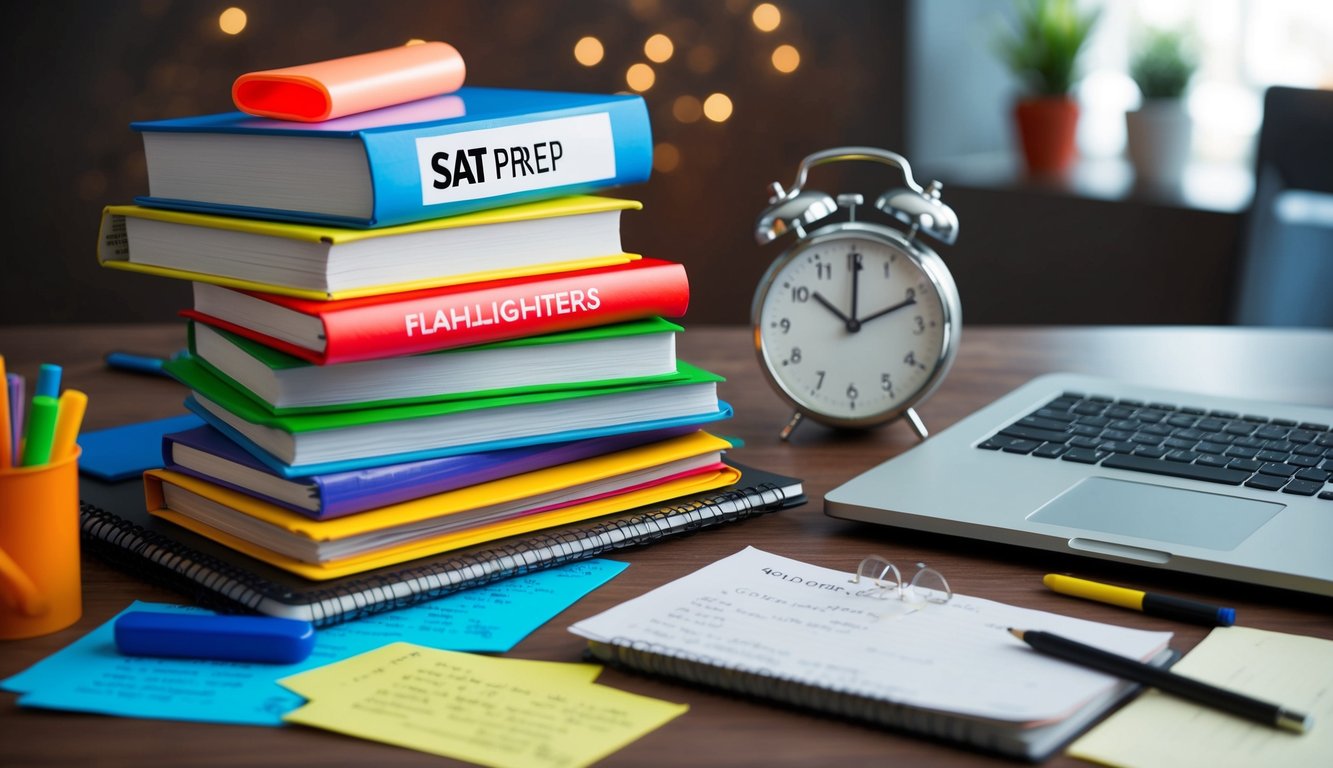
Being ready for test day is key. You need to bring the right items and do some simple prep the morning of the exam.
What to Bring to the Testing Center
Make sure you have these items:
- Admission ticket (print it out)
- Valid photo ID
- Several sharpened #2 pencils with erasers
- An approved calculator
- A watch (without alarms)
- Snacks and water for breaks
Don’t bring:
- Cell phones
- Smart watches
- Any unapproved electronics
Put everything in a clear bag for easy inspection. Arrive at the testing center at least 30 minutes early to check in and find your room.
The Morning of the Exam
Wake up early and eat a good breakfast with protein.
Dress in layers so you can adjust to the room temperature. Do some light exercise to wake up your brain.
Review these quick tips:
- Double check you have all required items
- Use the bathroom before leaving home
- Bring a bottle of water and snacks
- Stay calm and focused
- Think positive thoughts
Avoid cramming or studying. Instead, relax and trust in your preparation. With the right items and mindset, you’ll be ready to do your best on test day.
Health and Well-being

Taking care of your health is key for SAT success. Good habits help your brain work better and keep you calm on test day.
Getting Adequate Rest
A good night’s sleep is crucial before the SAT. Aim for 8-9 hours of sleep the night before.
Set a bedtime routine to help you relax:
- Turn off screens 1 hour before bed
- Read a book or listen to calm music
- Do light stretches or deep breathing
Avoid caffeine after 2 PM. A warm bath or shower can help you wind down.
If you’re nervous, try writing your worries in a journal. This can clear your mind.
Don’t cram late at night – it won’t help and may hurt your sleep.
Nutrition and Hydration
Eat a healthy breakfast on test day. Choose foods that give lasting energy:
- Whole grain toast with peanut butter
- Oatmeal with fruit and nuts
- Greek yogurt with granola
- Prioritize protein-rich foods like eggs
Avoid sugary foods that may cause an energy crash. Stay hydrated by drinking water throughout the test.
Bring a water bottle to sip during breaks.
Pack smart snacks for the break:
- Apple slices with cheese
- Trail mix
- Granola bar
These foods can boost your focus and keep your energy up. Eating well supports your brain function and can improve your SAT score.
Frequently Asked Questions

Students often have burning questions about last-minute SAT prep.
Let’s look at some key strategies for different sections of the test and ways to boost your score quickly.
What are the most effective last-minute study strategies for the SAT math section?
Focus on reviewing key formulas and concepts. Make flashcards for important math rules and go over them several times.
Practice solving problems quickly without a calculator. Look over old practice sections to refresh your memory on common question types.
Try timing yourself on sample math problems. This helps build speed and confidence.
Don’t forget to brush up on geometry and algebra basics. These show up often on the test.
How can one quickly improve their reading comprehension skills just before taking the SAT?
Read short passages and practice summarizing the main ideas. Work on identifying author’s purpose and tone in different texts.
Do timed reading exercises to build your speed.
Try skimming passages first before diving into questions. This gives you a general sense of the content. Focus on learning strategies to eliminate wrong answer choices rather than always finding the right one.
Are there any proven quick tips for enhancing SAT grammar skills right before the test?
Review common grammar rules like subject-verb agreement and pronoun usage. Practice identifying errors in sample sentences.
Learn to spot redundant phrases and wordy constructions.
Do short grammar quizzes to test your knowledge.
Pay extra attention to punctuation rules, especially commas and semicolons. These often trip up test-takers.
What digital SAT tips should testers keep in mind when preparing at the last minute?
Familiarize yourself with the digital testing interface. Practice using the onscreen tools like the calculator and answer eliminator.
Get comfortable navigating between questions and sections.
Try some full-length digital practice tests to build stamina.
Learn keyboard shortcuts to save time during the exam. Make sure you know how to properly use scratch paper for notes and calculations.
How realistic is it to significantly improve one’s SAT score with only one day of preparation?
Major score improvements are unlikely with just one day of prep. Focus on reviewing your weakest areas and brushing up on test-taking strategies.
Go over practice questions you’ve gotten wrong before.
Get a good night’s sleep and eat a healthy breakfast. Being well-rested and fueled can boost your performance. Don’t cram new content – stick to reinforcing what you already know.
What approaches can help boost an SAT score by 300 points within two weeks?
Take several full-length practice tests to build endurance. After that, analyze your mistakes and focus your study time on weak areas.
Next, learn time management strategies for each section.
Create a study schedule and stick to it. Practice a mix of content review and timed question sets each day. You can also consider working with a tutor to target your specific needs.
View our Recent BFFS Scholar Quest Content here!
- 25 Fully Funded Scholarships New Zealand: International 2026
- 25 Fully Funded Scholarships Hungary: International Students 2026
- 25 Fully Funded Scholarships in Poland: International Students 2026
- 25 Fully Funded Scholarships Hong Kong International Students ´26
- 25 Fully Funded Scholarships in Taiwan: International Students 2026
